

Writing Framework – What it means for primary literacy

Discover how to turn the DfE’s new Writing Framework into practical strategies that boost both technical accuracy and student creativity without adding unnecessary pressure…

- by Teachwire
- Classroom expertise and free resources for teachers

In July 2025, the DfE published the Writing Framework, a landmark 150-page guidance document for primary schools in England.
Following on from the Reading Framework in 2023, this non-statutory guide aims to transform how writing is taught in primary schools, offering practical, evidence-based strategies from Reception through Key Stage 2.
Breaking down the Writing Framework
Foundations first
At the heart of the Writing Framework is a recognition that writing is cognitively demanding. Pupils’ working memory must manage letter formation, spelling, sentence structure and composition simultaneously, making automaticity in handwriting and spelling essential.
Through learning transcription early and well, children gain the mental space to focus on ideas. The Writing Framework advises explicit teaching of handwriting and phonics-based spelling from Reception, reinforcing these skills into KS1 and beyond.
The result: automatic transcription skills that support fluent writing.
Sentences over grammar
Rather than teaching grammar in isolation, the Writing Framework recommends sentence-level instruction, using grammar and punctuation as tools to convey meaning within context.
Pupils are encouraged to compose orally before writing, as they build transcription fluency.
The process of writing is seen to be essential, with publishing or sharing identified as the final step.
The Reception year
The Writing Framework cites Reception as the most vital year for establishing strong writing foundations, where children learn letter formation, correct pencil grip and basic spelling or transcription skills.
The framework is clear: quality over quantity. Pupils should not be expected to write long pieces until their transcription skills are secure.
Encoding vs decoding
Building on the success of the Reading Framework, the new Writing Framework frames phonics not just as a reading tool, but as a foundation for spelling, especially into Key Stage 2.
It reinforces the Simple View of Writing, comprising of two equally vital components: transcription and composition. Dictation is recommended weekly to solidify spelling and sentence structure.
Writing culture
Leadership plays a central role. Headteachers and literacy leads are expected to:
- Cultivate a positive writing culture, where pupils write meaningfully every day.
- Sequence a coherent curriculum from Reception to Year 6. This means schools should identify writing opportunities, map contexts and look at planned coverage.
- Ensure all teachers (not just subject leads) are trained to teach writing effectively.
This is not a prescriptive scheme or checklist, but a flexible, evidence-informed guide with reflection points for teacher development.
Impact on teaching
Reception teachers:
- Prioritise handwriting posture, letter formation and grip
- Teach phonics-based spelling explicitly, from the outset
- Use oral composition to rehearse sentences before pupils write
KS1 and KS2 teachers
- Sequence lessons so transcription remains automatic, and fluency grows
- Continue phonics and dictation to consolidate spelling and sentence structure
- Embed grammar teaching within composition, not as isolated lessons
- Ensure audience and purpose sit at the heart of writing
For school leaders
- Designate literacy leads to oversee integration of reading and writing
- Promote writing across all subjects
- Offer CPD aligned to the framework so teachers can implement ideas confidently
The Writing Framework represents a major shift in primary writing pedagogy. By centring transcription skills, emphasising oracy, prioritising sentence instruction, and weaving in phonics-based spelling through KS2, it offers a research-grounded roadmap to develop fluent, confident writers.
Its layered approach, starting with Reception and coupled with a focus on equity, leadership and teacher training, aims to raise writing standards across England’s primary classrooms.
Lynn Sear is a former primary teacher and writing moderator, and is now the co-CEO and co-founder of Literacy Tree.
Writing Framework podcast
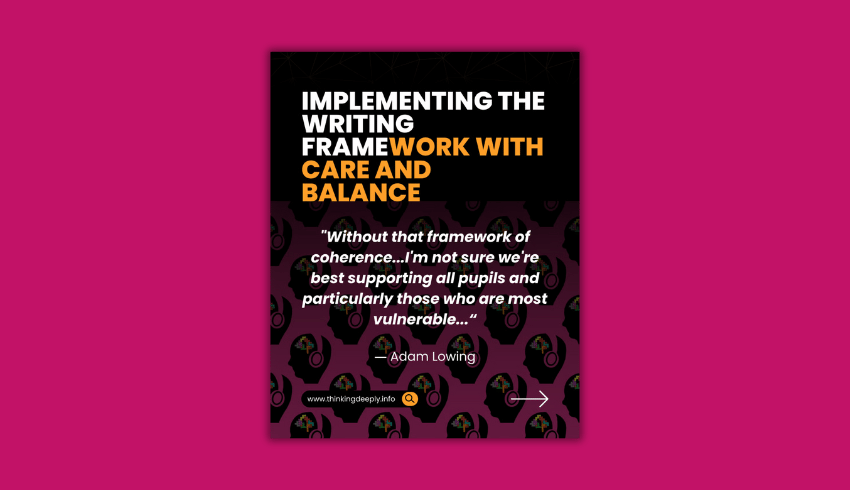
In this episode of the Thinking Deeply About Primary Education podcast, host Kieran Mackle is joined by former primary headteacher and English SLE, Adam Lowing, to talk about the DfE’s new Writing Framework.
Together, they get beyond the ‘hot takes’ on the Writing Framework, looking at what it actually says and why sentence‑level precision and transcription fluency are the foundations of confident writing. They also discuss how schools can transition without chaos.
Additionally, Kieran and Adam dig into model texts, assessment pressures and the role of the subject lead in making change stick.
Key takeaways
- Technical accuracy and transcription fluency support, not stifle, creativity in writing
- Sentence-level precision reduces cognitive load and frees students to be imaginative
- Create time and space for staff dialogue to unpack what the Writing Framework actually says
- Allow teams freedom to define what imagination and creativity look like in your context
- Focus teaching on authentic writing experiences instead of excessive test preparation
- Use a rich curriculum to improve motivation and ultimately outcomes, not narrow assessment drills
- The Writing Framework emphasises technical foundations but is not comprehensive on creativity
- Leaders should interrogate the research and enrich creative practice locally
- Unpack the Writing Framework as part of wider curriculum improvement, not a compliance checklist
- Give subject leads the time to read and translate sections into practical classroom change
Adam Lowing is currently supporting schools across the country with Leading English, working to empower staff to raise standards in English.