

William de Ferrers School – Tackling behaviour and staff retention
Callum Fauser looks at how the leadership of William de Ferrers School in Essex has gone about tackling those all-too-common issues of student behaviour and staff retention…

- by Callum Fauser
- Editor of Teach Secondary magazine
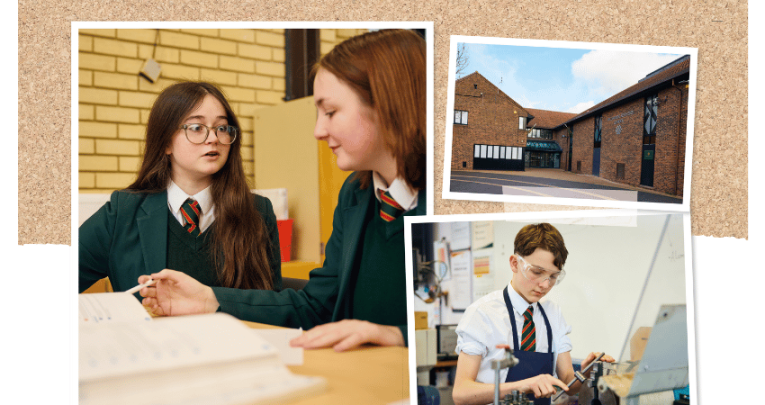
Without wanting to sound disparaging, most secondary schools exist as islands. Even in the densest parts of inner-city London, they’ll usually be clearly set apart from their immediate neighbours behind a high fence or situated well away from the nearest road, leaving visitors in no doubt as to where the school’s boundaries begin and end. William de Ferrers School isn’t like that.
Originally opened during the early 80s in South Woodham Ferrers – a small Essex town roughly equidistant between Chelmsford and Southend – its buildings originally formed part of a unique social space shared with the rest of the town.
The school’s classrooms and staff areas were originally under the same roof as the town’s library, local community facilities and even a licensed bar.
Things have changed a bit since then. The bar is long gone. The library now has its own discrete premises. But William de Ferrers School remains uniquely enmeshed within the town.
A leisure centre sits directly next door. The entrance to reception opens out onto the pavement, with a line of local takeaways and restaurants visible on the other side of the road.
“William de Ferrers School remains uniquely enmeshed within the town”
An island it is not. However, the electronic sign-in systems and security doors necessary to satisfy modern safeguarding requirements are all present, as you’d expect.
Strong foundations
As with many other secondaries since 2010, those changes have also included academisation. In 2024, the school became part of The Chelmsford Learning Partnership (CLP).

This was a move that saw the arrival of executive headteacher, James Donaldson. He had previously overseen the opening of The Beaulieu Park School, Essex’s first all-through school in nearby Chelmsford.
As Donaldson tells it, “CLP’s due diligence highlighted some areas where the school could benefit from additional support and investment, particularly around behaviour systems and overall consistency.
“These were not unusual challenges, and it was clear that the school had strong foundations on which we could build.
“Once my September 2024 start date was confirmed, I considered how best to begin the year. I weighed up establishing a set of clear routines early or spending longer observing before making changes.
“In the end, introducing a few well-chosen expectations from the outset felt like the right balance. It gave everyone clarity, while still allowing time to understand the school more deeply.”
Fortuitous timing
Donaldson ultimately opted to make a number of early strategic changes aimed at setting the right tone and clearly communicating the leadership’s intentions to the rest of the school.
That decision turned out to be well-judged when the school was notified of an Ofsted inspection during the third week of September.
For a new leader, such timing can be challenging, but in this instance it also proved beneficial. “In many ways, the timing was fortuitous,” Donaldson reflects.
“Ofsted heard some longstanding, historic concerns. But the overall parent and staff feedback was extremely positive, which reinforced the direction we were taking.”
Ofsted’s inspection report ultimately rated the school Good across all areas, barring a ‘Requires Improvement’ for quality of education.
With the outcome of the inspection serving as a mandate of sorts, Donaldson and his colleagues set about tackling those issues.
- As you walk around the school, you’ll see the school’s ‘ARRK values’ displayed on the walls:
- > Aspiration
- > Respect
- > Responsibility
- > Kindness
- The school’s rewards system is now built around those values, whether it be end-of-term rewards or the cards children carry around with them as a form of positive personal reward.
- They’re not values that are attached to ability – we can all aspire, we can all be kind. They’re about how staff and students try to operate alongside each other, at whatever
level.
Odd architecture
“One of our early steps was to bring behaviour systems together, so that expectations were consistent for everyone,” Donaldson notes.
“Centralising detentions meant pastoral and senior staff could support students effectively and helped reduce unnecessary workload for teachers.”
At the same time, the school also introduced same-day detentions. “They’re not especially long, but it means there’s now an immediate consequence in place,” Donaldson explains.
“Form tutors are notified when they need to bring a child down at the end of the day. We want to draw on those existing relationships – ‘Johnny, you have a detention, down we go’. This is so that we can get things quickly done and dusted.”
Another consideration concerned the school’s architecture. As Donaldson explains, “The school’s original 1980s multi-use design created some supervision challenges that wouldn’t meet modern safeguarding expectations.
“We want to draw on those existing relationships”
“Certain areas were tucked away or difficult to monitor, which meant we needed to rethink how some spaces were used.
“Students had fed back for a long time that some of the older toilet areas didn’t feel welcoming or well-located.
“As part of modernising the building, we invested in a new, centrally located toilet block. It’s brighter, safer and much more in line with what students expect today.”
Growing reputation
Another key priority at William de Ferrers has been teacher retention. “Exit surveys before academisation reflected a mixture of reasons for staff decisions to move on, including suggestions that behaviour systems could be strengthened,” Donaldson recalls.
“One year on, staff retention is extremely strong, with only one colleague leaving for a well-deserved promotion.”
What would Donaldson cite as being the main factors behind that positive shift? “Our reputation is improving, to the point that staff are wanting to stay and new staff are wanting to join us.
“Applicants know what we can offer them from being part of a supportive MAT – trust-wide professional development expertise, as well as a health package that includes online GP appointments, which colleagues really value.
“One year on, staff retention is extremely strong”
“Our current direction of travel, our values [see panel], our growing student values – it all seems to have worked.”
Unique qualities
When visiting a school like this, I’m always looking out for those unique qualities – the things that a school does or can offer that set it apart.
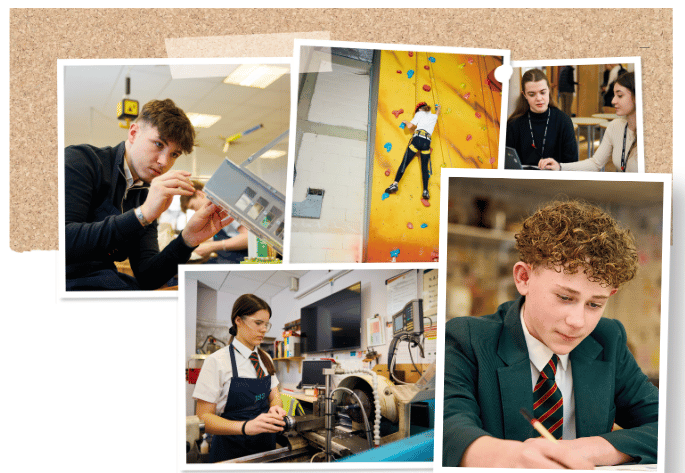
Our tour of the school grounds briefly stops off at both a full-size climbing wall and a well-equipped multigym, complete with sophisticated-looking treadmills, rowing machines, exercise bikes and full complement of weight-training equipment, both playing host to a lively class of Y8s.
So what would Donaldson consider to be the school’s most distinct characteristics?
“In my experience, when behaviour and relationships are strong, teachers and students can thrive. That’s why our early focus was on strengthening culture and routines so that the best possible conditions for learning were in place.
“We’re now building on that foundation to continue improving teaching and learning across the school.”
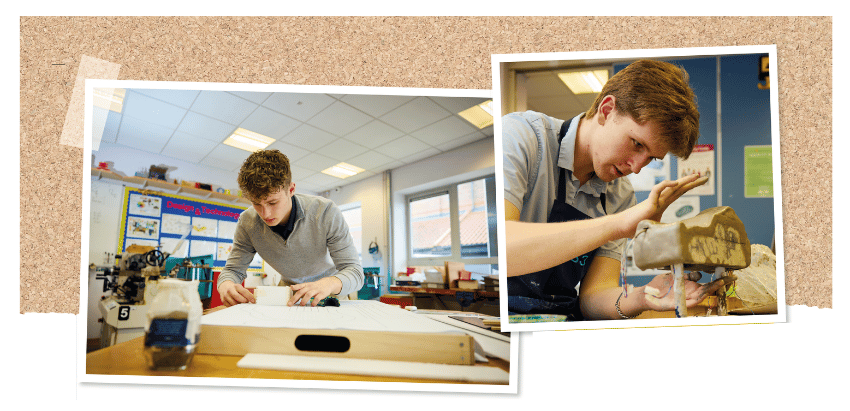
- Baz Dimopoulos is head of the school’s D&T faculty…
- I work alongside colleagues who have prior knowledge and experience of 3D modelling, high-end construction, graphic design, catering and AI.
- We work as a team, using each other’s specialisms to design a curriculum that offers a wide variety of skills for the students, and the school supports us with budgets.
- Having D&T staff with backgrounds in engineering, 3D modelling, construction and product design has helped the department advance in terms of what we can now teach.
- You can see the results in students’ practical skills and familiarity with processes like laser cutting and 3D printing.
- We design projects that our students will want to make, and which combine elements of both modern technology and traditional skills.
- We’re still taking students through the processes of marking out, cutting, drilling by hand and those sorts of things, but then combining those with computer-aided design, 3D printing, laser cutting and other technologies.
- What’s changed recently is that many students have previously played games like Minecraft to express their creativity, which has helped develop their visualisation skills when engaged in 3D modelling activities.
- The standard of models and level of detail we now see being produced at younger ages is fantastic.
- The bottom line for me is that I want students to get into industries they aspire to join, attend their preferred university, and/or secure the apprenticeship they want at the end of KS5.
- The technology is evolving so quickly, but with the team we have, we all feel excited to adapt with it.