
Maths games KS1 – Free interactive offline and online ideas
Revitalise your KS1 maths teaching with these exciting game ideas, aimed at sparking curiosity and bolstering skill development…

- by Teachwire
- Classroom expertise and free resources for teachers
Enhance your maths lessons with these innovative and enjoyable maths games KS1 ideas – designed to spark interest and improve understanding in your young learners…
Table of contents
Easy offline maths games for KS1
Shut the box
This game is brilliantly simple but has many hidden mathematical depths. It provides ample opportunity for rich mathematical talk, which is something we need to encourage in every maths lesson.
Shut the box rules
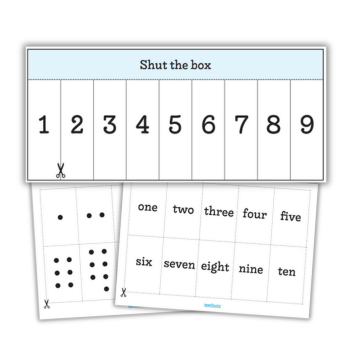
Create a resource from paper that features numbered flaps from one to nine (or download our free version).
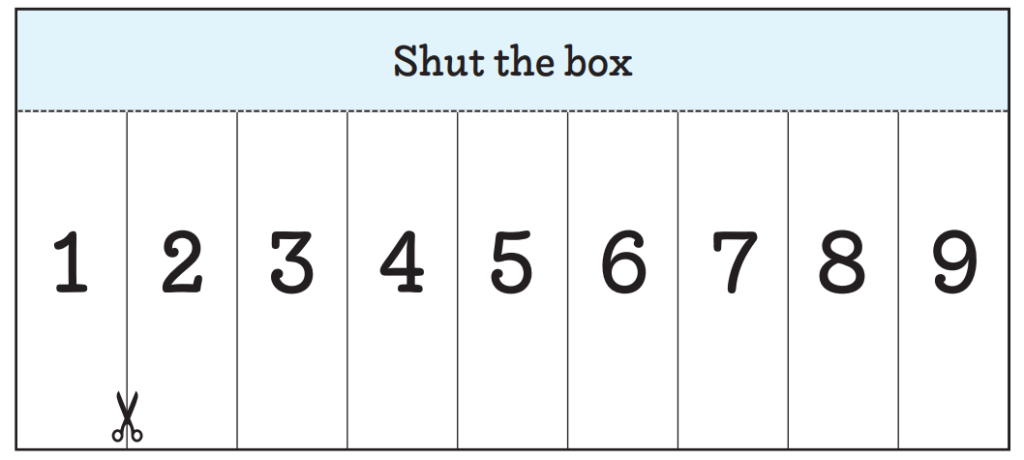
Begin the game with all the flaps open. The aim of the game is to roll a dice and shut the box by closing all the flaps.
Keep it simple to begin with: for example, if pupils roll a two and four, they can shut the corresponding flaps. Next, move on to using the sum of the dice. So, for example, if you roll a two and four, shut the six flap (2+4=6). Likewise, if you roll an eight, shut flaps that add up to that number (1+2+5, for example).
Kieran Mackle has made this superb video about this game, where he demonstrates different scenarios:
The conversations that can be had while playing this game open up a dialogue around number, which enables you to pick apart a child’s understanding, as well as their ability to subitise and calculate mentally. This game can be played early on in primary school, in intervention groups or even as a fun filler further up into KS2.
Battle frames
This is like the game Battleships, but with ten frames and counters. It’s ideal for developing that vital number sense we need to nail in EYFS and Y1. It requires children to visualise numbers.
How to play
Give each child a ten frame (or two if you’re playing with numbers to 20) and some counters. Pupils must represent a number using counters on the ten frame, then their partner has to guess the number by asking questions such as:
- Is there one full row/column?
- Is there an odd number of empty boxes?
- Is the ten frame full?
Pupils’ questions will get better and better as they get used to playing. They’ll start to realise which questions really help uncover a number’s structure.
For example, if a child replies ‘yes’ to the question ‘Is the left column full?’, then their partner knows the number must be five or more. Likewise, if they answer no, then the number must be between zero and four.
When starting off, I suggest you keep to a filling rule such as ‘We keep the ten frame vertical and fill in the left column first, from the top down.’ This means children have a chance of guessing the numbers. Then you can move on to having no filling rules and seeing how children change their questioning tactics.
Subitising snap
We’ve all played snap, but have you tried subitising snap? Subitising is the ability to instantaneously recognise the number of objects in a group without counting them. It’s a vital part of early number sense development. This game is a fun, but purposeful, way of practising.
How to play
Create a pack of subitising snap cards made up of digits, dots, pictures of objects, counters on ten frames and dice patterns for the numbers one to ten (or download our free pack).
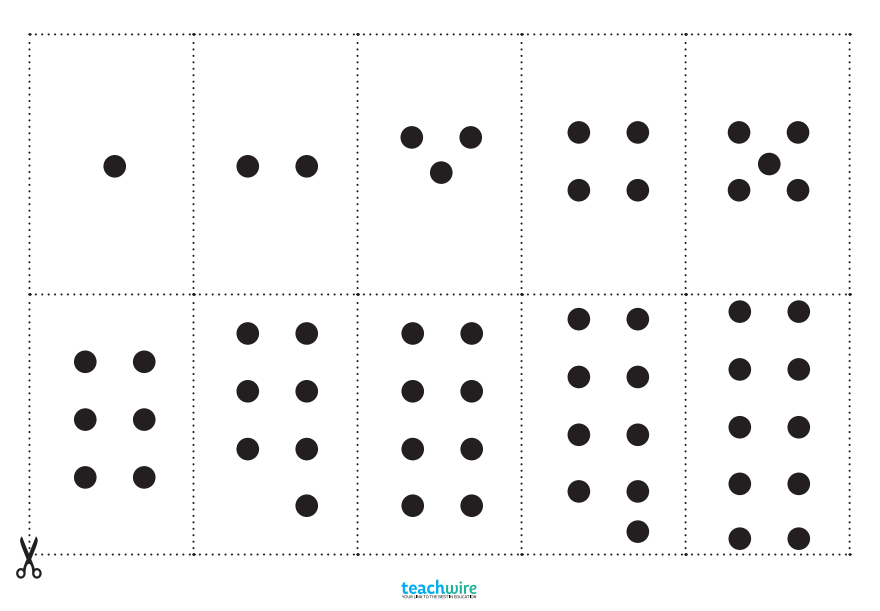
Children can play in pairs or small groups. Deal all of the cards, then one by one, ask players to reveal a card and place it in the middle of the group. When there are two cards representing the same number, players should shout “Snap!”. The first to shout it wins that round and puts those cards to the side. The winner is the player who wins the most rounds.
This game forces children to use their subitising skills because to win snap you need to be speedy. They will become more used to recognising numbers shown in different representations, which will lead to better fluency later on.
Thanks to Shannen Doherty for the above ideas.
Difference Connect 4
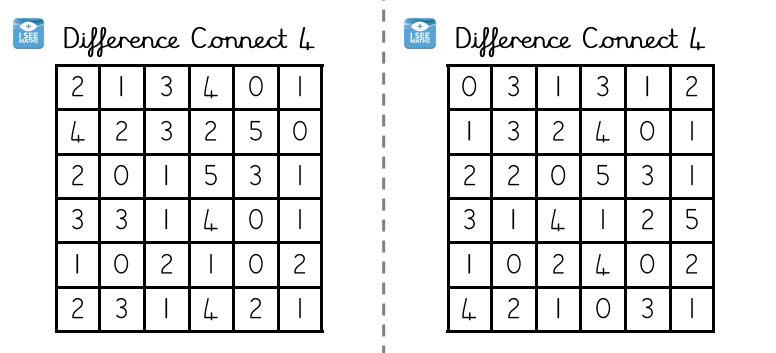
This Connect 4-style game helps children to develop a strong ‘number feel’ and early calculation strategies. Sitting in pairs, take it in turns to roll two dice. Find the difference of the numbers on the dice and choose the number to cross off. The winner is the first person to connect 4 boxes.
This game improves calculation fluency and also develops strategic thinking.
Doubles cards
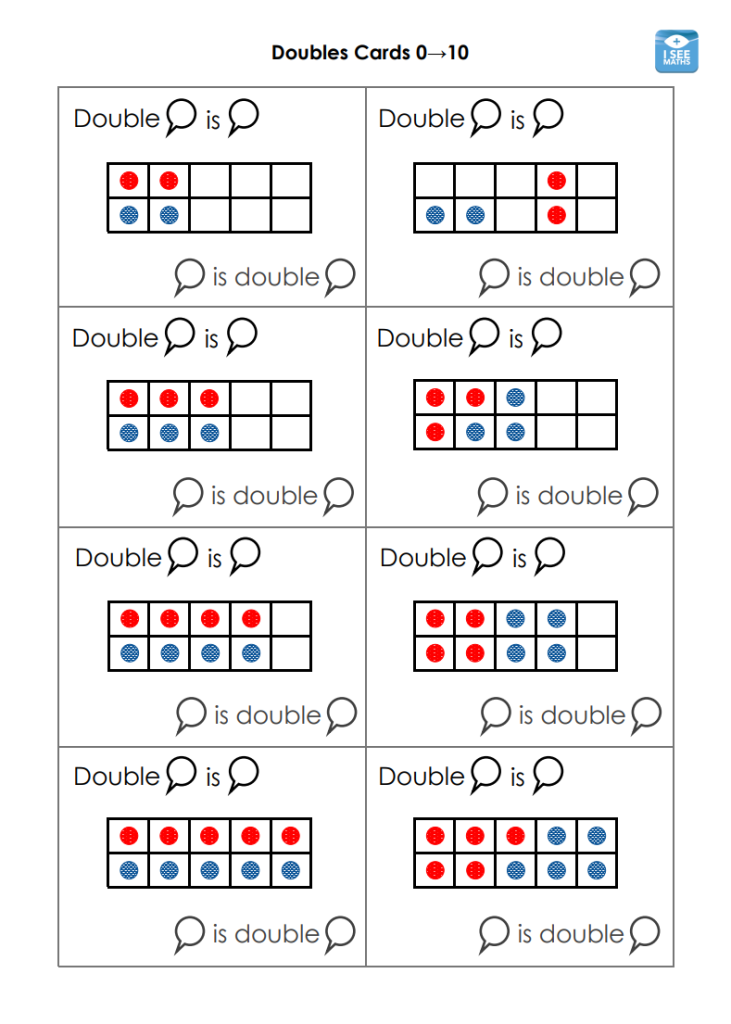
These Doubles Cards show doubles up to 20 within 10-frames, helping children to visualise these number facts. Cut out the cards then turn over one card at a time. Ask children to say the double fact shown on the card.
Count on races
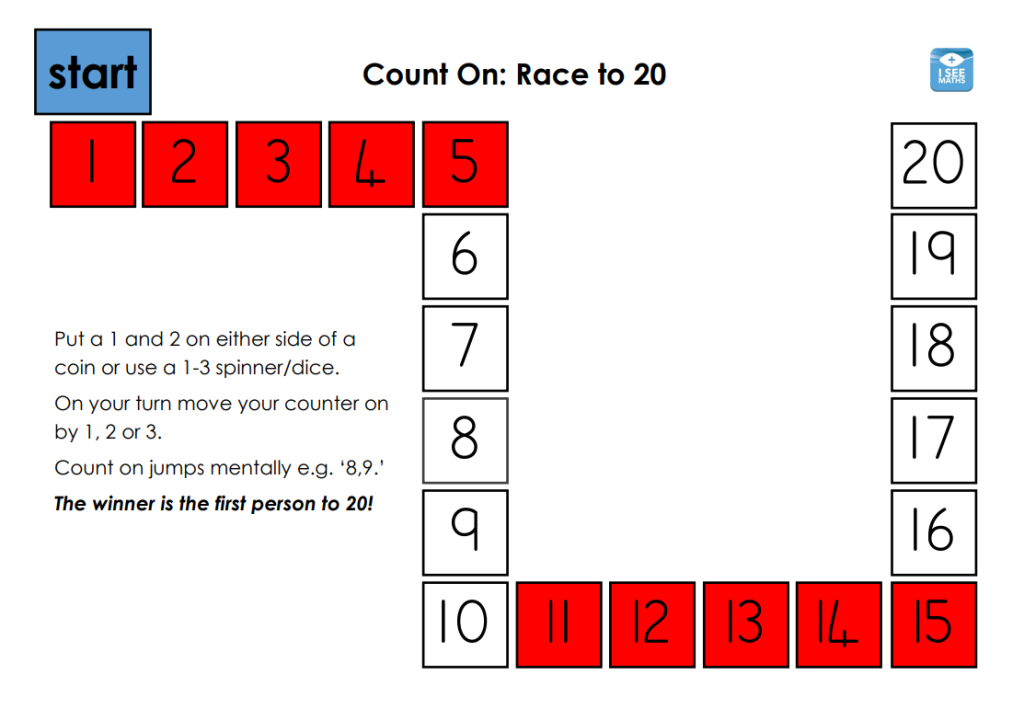
Use this counting on racing game to help children learn to count on mentally. You’ll need a coin or a dice/spinner with 1-3 on it. Children say the next number when counting on. For example, when starting from 7, for a jump of 2 they say ‘8, 9’.
Number bonds games
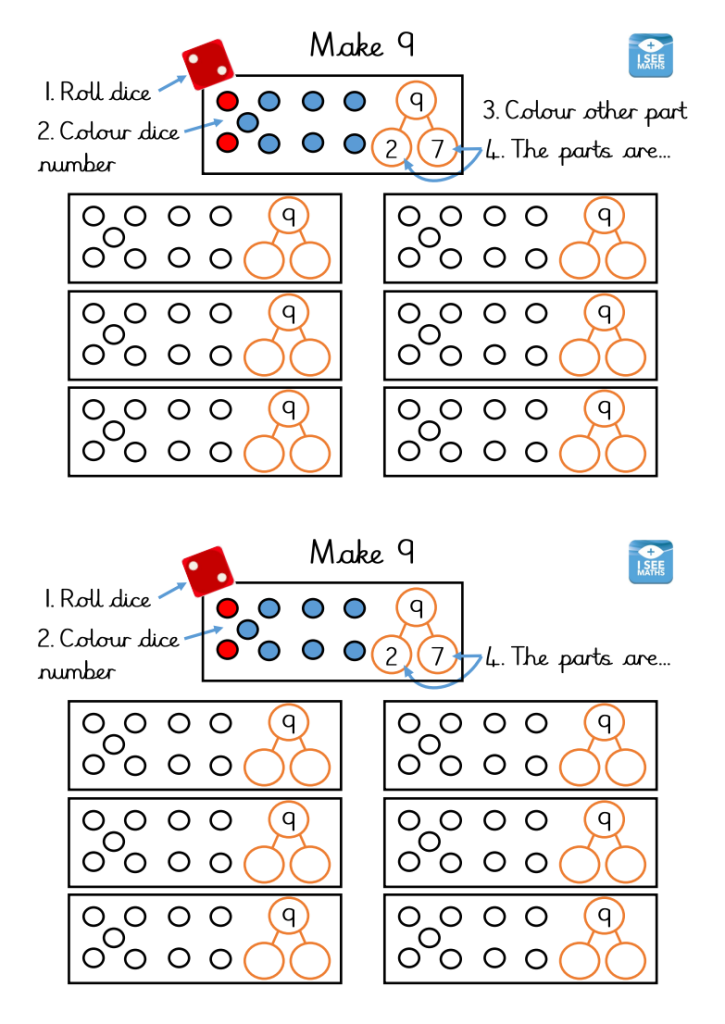
In these number bonds games, children roll a dice and colour in the number of circles on the dice. Then they colour in the other part. Students then write down the two parts that the whole number is broken into.
How many fours?
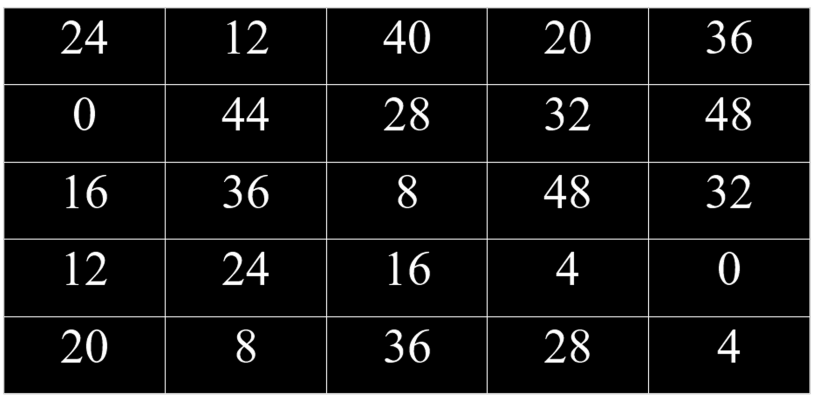
In this How Many Fours? game for two people, take it in turns to work out how many 4s (or potentially 2s) you need to make a series of different numbers. Place a counter on the grid if you’re correct. The first player to form a ‘Connect 4’-style horizontal, vertical or diagonal row of counters is the winner.
Make arrays with dice
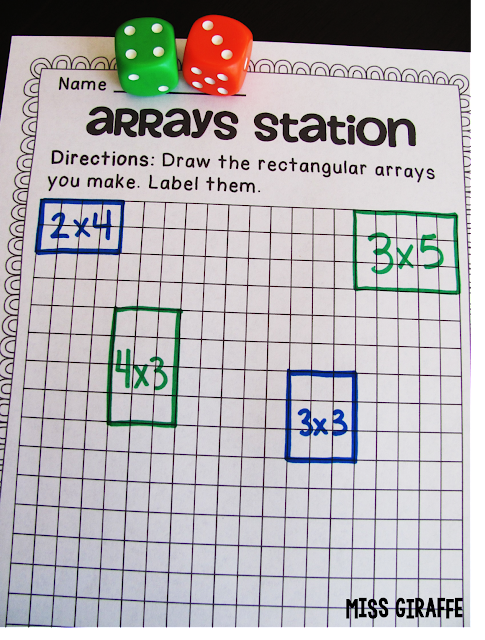
For this arrays dice activity you need to give students two dice and square paper. Roll the dice to figure out what array to draw. For example, if you roll a 4 and a 3, you have to draw a box that is 4×3 and write 4×3 inside it. How many arrays can pupils fit in without any overlap?
More hands-on KS1 maths games and ideas

Encourage children to make connections between hands and head, with these excellent ideas from Juliet Robertson…
Ideas with sticks
- At a gathering circle, use sticks to tap along to the beat of a song. This is an entry point into counting games. From here, move onto activities such as counting forwards while slowly tapping one stick on the ground in time to each number said aloud. Encourage all the children to join in with counting along. Work on developing a steady rhythm.
- Develop a collection of sticks cut to specific lengths: 1m, 90cm, 80cm, down to 10cm or 5cm. These can be used to represent, order and manipulate numbers in different ways. They are also valuable for exploring length. Colour code the ends to help with quick identification. Also useful are 25cm and 33.3cm lengths, for fraction investigations.
- Mark 10cm intervals on a one metre stick. It is useful for rounding to the nearest ten and quick estimates, such as how deep is a puddle, how wide is a door, how long is a path or how high is our sunflower. The intervals can be counted in tens or ones, depending on the child’s level of understanding.
- Use a stick to form numbers in puddles or draw numbers in sand, mud or grit. What is the biggest number possible which can be made in the space available? Air write numbers. Attach ribbons or string for added effect. Make numerals using little twigs.
- Ask the children to collect an agreed number of sticks – for example, each child goes and finds ten sticks and brings them back to the gathering circle. The challenge is for each child to make a picture with their own ten sticks. Everyone can step back and comment on the different pictures created.
Ideas with stones
- Create an estimation jar for the children to play with outside. The children fill it with pebbles then have to estimate how many objects are in the jar before counting them.
- With a partner, the children collect 20 stones to use as counters. Taking it in turns, each child chooses to pick up one, two or three counters. The player who picks up the last counter loses the game.
- Discuss which rock is heaviest and which is lightest. Is it true that the biggest stone is also the heaviest? Challenge the children to find a rock which feels heavier than the heaviest rock or a stone that feels lighter than the lightest rock.
- How many stones make one kilogramme? Create collections so everyone can compare the similarities and differences. Is it possible to find one stone which weighs a specific standard unit, such as one kilogramme? If so, keep hold of it as it is a special weighing stone. It can be marked and used with balance scales to measure the weight of other objects. This challenge works well on a stony beach, so take a set of balance scales for this purpose the next time you go.
- How many different patterns can you create on a 3×3 grid by placing five stones within in? This is surprisingly complex as it raises discussions about what constitutes a unique pattern. Adults can model how to record the different patterns through taking photos or noting down the patterns on paper.
- Flat stones lend themselves to miniature stacking and balancing challenges. To increase the level of challenge, have a collection from which children need to pick out the flat stones to make them stack.
These ideas are taken from Messy Maths by Juliet Robertson (£18.99, Crown House Publishing).
Online maths games for KS1
The Canine Crew from BBC Bitesize
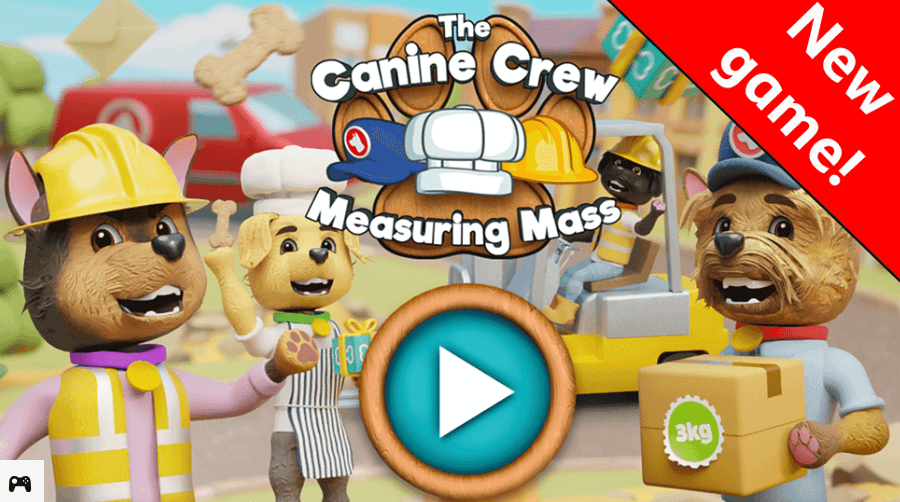
Online KS1 maths game The Canine Crew features a bakery, post office and building site – each offering tasks designed to help children practise their measuring skills. After playing the game, replicate these digital scenarios in your own classroom:
Physical post office role play: set up a classroom corner as a post office. Children can take on roles such as postal workers, customers or delivery staff. This hands-on context allows them to physically handle objects, compare weights and measure sizes, providing tangible experiences of mass and size.
Sorting and classifying activities: provide a variety of construction objects for children to sort into ‘light’, ‘medium’ and ‘heavy’ baskets, or arrange them from smallest to largest.
Market stall and shopping list: set up a market stall of items. Give children a recipe from which to make a shopping list. Include items sold in sets, such as eggs, and items sold by weight, such as flour.
Coconut multiples
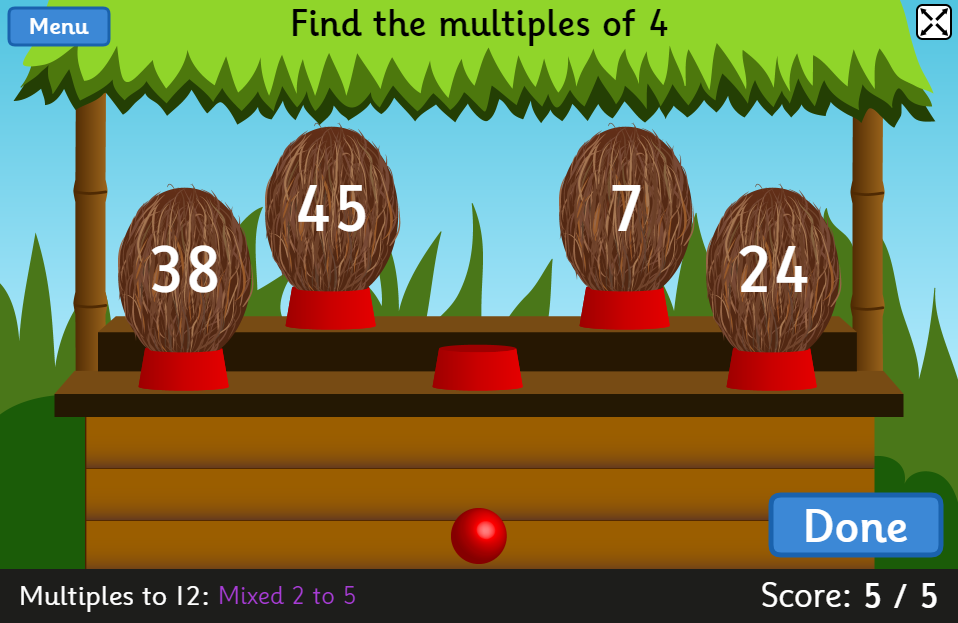
This coconut shy game can be differentiated a number of different ways. You can focus on any times table from 2 to 12, or you can play with a mixed bag of multiplication questions from 2-5, 6-12 or anything from 2-12.
You’re given five coconuts, each containing a different number, and you’ll be asked which ones are a multiple of your chosen number. Your job is to throw a ball at the correct answers, and click done once you’re sure you’ve left only incorrect answers standing.
Museum of tens
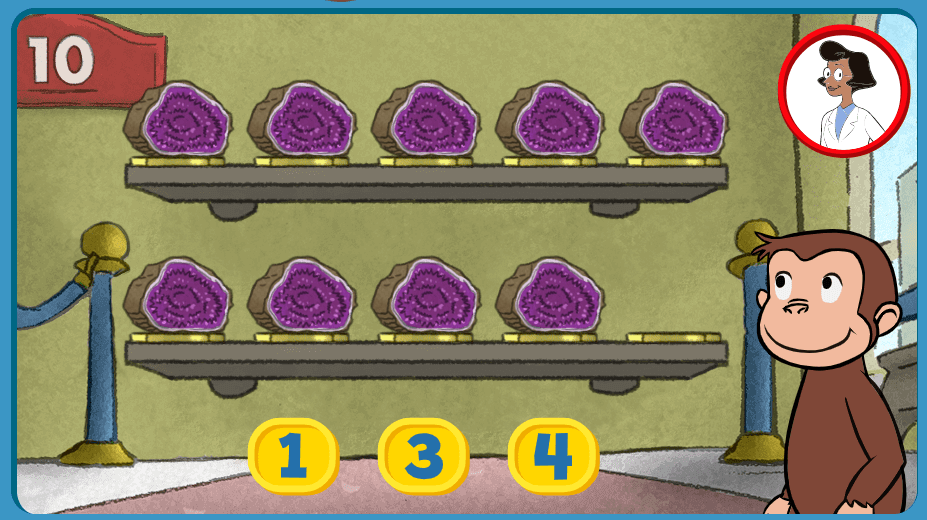
Learn number bonds to 10 with this Curious George: Museum of Tens number bonds game.
Follow him around the museum where each exhibit should have 10 items, but some are missing. It’s your pupils’ job to help George work out how many more they need to make up 10.
Symmetry matching
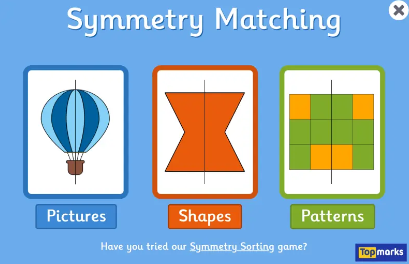
Symmetry Matching involves mirroring an image along a line of symmetry. Choose from pictures, shapes and randomly generated patterns.
Nrich games for KS1
Develop children’s mathematical problem-solving and reasoning skills with Nrich’s assortment of online games that don’t require teacher input. Choose from time-themed games, times table games, shape games and lots more.
Turning online maths games into hands-on learning in KS1
Combining digital maths games with real-world, hands-on role play creates low-pressure, playful learning that helps young children better understand, practise and apply mathematical concepts in meaningful ways, explains Dr Alison Borthwick…
Using digital games to support teaching and learning has been a part of classroom pedagogy for many years, and there is a wealth of resources across many subjects.
Within maths, many place children in digital versions of real-world scenarios, where they can do a wide range of things including counting, measuring, comparing, or sorting.
This helps pupils begin to understand numbers and concepts and to see how maths can, and will, fit into their daily lives outside the classroom in a way that allows for endless practice.
At the same time, there is a long tradition of providing opportunities for young children to engage and experience real-world play scenarios, from shops to kitchens to restaurants.
Thinking about how we can combine these seemingly quite different approaches to learning offers interesting opportunities.
Combo approach
Often, the digital game is seen as an add-on resource – something that might be used to reinforce learning at home, as part of continuous provision in early years and as ‘golden time’ type activities in KS1.
But digital games can also inspire real-world play scenarios in the classroom. This extends the value and impact of the game, and helps children to explore the concepts through their physical play experiences.
For example, you may talk about money in class. This activity could run alongside the use of coins, offering children the chance to play a digital game, and setting up a shop in school.
Collectively, this allows children to apply their learning in a variety of different physical activities with their peers.
Giving pupils the chance to focus on each stage of their learning individually – number work, physical handling of coins, and the understanding of how this maths is used – sets up multiple opportunities to consolidate and reinforce learning.
Digital games as a stepping stone, or a follow-on, to real-world activities offer children the chance to play in a non-threatening environment where they often feel less pressure around mistakes they may make within the game play. It can offer a chance to replay the scenarios again and again to build confidence.
Strengthening the link between digital games and classroom practice also enables children to model the activity they have interacted with on-screen and to extend it.
This borrows thinking from the well-known CPA approach (Concrete, Pictorial and Abstract), with the digital resource providing an excellent visual representation of the real-life challenge.
Low-stakes learning
Playful learning – whether digital or analogue – is a powerful approach, especially for young children. While I am sure we would all agree that young children play, this isn’t the same as playful learning.
For me, playful learning is almost always goal-orientated, creative and less constrained by rules or perceived expectations than traditional lessons.
In a word, it is joyful, and pleasure is taken from the exploration of a context. It can involve risk-taking, determination, increased autonomy and agency because it is all about an individual’s engagement with that context.
It promotes self-awareness and self-regulation. Children see themselves as able to contribute; they need to think and therefore develop their personal agency.
Within digital games, all of this can be present while still making sure the setting feels relaxed, and things don’t get too competitive.
Practical strategies
Bringing popular educational digital games ‘to life’ in the classroom is exciting for children, particularly in KS1. The activity enables pupils to the value in learning in different ways, and may particularly benefit children who are struggling with the conceptual elements of mathematics.
For example, handling money and relating it to written numbers can be tricky for some pupils. Setting up a market stall with real coins is a great way of giving children a chance to handle money, and to explore addition, subtraction and exchange in their role play.
The inclusion of price stickers will support relating the coins to their numerical value. The BBC’s digital game, Space Shoppers, reinforces these money-handling skills in a digital world.
Another option might be to add a post office with weighing scales to help children work with heavier and lighter wrapped ‘parcels’ that need to be sorted. Children can then try relating these weights to their numerical values.
This can be paired with Canine Crew, a digital game that includes tasks to help ‘Postie Dog’ with sorting and measuring the mass of parcels.
Careful thought is needed to bring digital games into real-life play scenarios. It’s worth asking: what is the learning and how can I best facilitate this? Which games will best consolidate learning or allow for experimentation and challenge?
By bringing the structure and excitement of digital games into the physical classroom, through imaginative role play and hands-on activities, teachers can make abstract mathematical concepts more accessible and meaningful while building confidence and embedding knowledge and skills.
Play-based approaches, including playful learning, not only deepen mathematical understanding but also nurture essential skills in communication, collaboration and problem-solving
Dr Alison Borthwick is a mathematics adviser to BBC Bitesize.
More maths resources
- Browse our maths games KS2 ideas
- Download our packs of Year 1 maths worksheets and Year 2 maths worksheets