

Lakelands Primary – “It’s all about empowering teachers”

A thorough and supportive CPD programme has helped Lakelands Primary grow from the ground up into a community treasure…

- by Charley Rogers
- Editor of Teach Primary magazine
It doesn’t feel high stakes,” says Mark Shean, teaching and learning lead, describing his experience of the thorough yet unintimidating CPD programme at Lakelands Primary School.
“Every school in the Trust, has a teaching and learning team, so we have comprehensive CPD, with agreed standards and frameworks across all the schools, so we know what to expect.”
But the story at Lakelands didn’t begin so smoothly…
Designed to serve a new housing estate in Colchester, Essex, Lakelands opened in 2020, in the midst of the Dark Ages of lockdown.
The school had only 24 children at first, despite having space for 60, and faced numerous challenges as the pandemic lingered; but it has more than pulled itself up by the bootstraps – and in fact, when I sat down with the team in early 2026, the school was oversubscribed in most year groups.
About Lakelands Primary
- Name: Lakelands Primary
- MAT: Chelmsford Learning Partnership MAT
- Headteacher: Koulla Anslow
- Location: Colchester, Essex
- Size: Approx 60
It was the fresh perspective of Lakelands that allowed it to blossom so quickly, says Koulla Anslow, who has been headteacher since the site opened.
“The school is new in building and in concept,” she explains. “We’ve worked really hard to develop our reputation in the area – when we opened during lockdown, people understandably didn’t want to take chances on a new school, so we were undersubscribed for a while.”
However, the school’s first Ofsted inspection in May of 2023 would change all that. And quickly. “We had a really positive result from Ofsted, and word soon got out,” says Koulla, “and now we’ve got a waiting list for almost every year group except Year 5, which is the one that started out as a group of 24” (the school hasn’t yet welcomed its Year 6 cohort, but hopes to in the near future).
These are impressive statistics on any scale, but it’s not just a glowing reputation with parents and children that fuels Lakelands’ success.
“We have an amazingly low staff turnover,” Koulla tells me. “In the six years we’ve been open, only two teachers have left”.
In a landscape where teacher retention is anything but low-stakes (Teacher Tapp reports that around 40 per cent of teachers in 2025 expect to have left the profession within three years), this is increasingly unusual.
Style and substance
What is it that makes Lakelands Primary so special? “I think it has a lot to do with our professional development programme,” says Koulla. “Our CPD is very carefully structured.”
The programme is mapped out from the start of each year, Koulla explains. “We plan our staff meetings, as most schools do,” she says, “but the difference here is that we’ve had the luxury of building everything from scratch.”
This includes the usual roster of updates to policy and guidance, such as training on the new Writing Framework, but Koulla and her team also dedicate a certain amount of staff meeting time to coaching.
“For example, we’ve run coaching for avoidance behaviours,” Koulla says. “Sometimes that’s external training, sometimes it’s delivered by our SENCo. Staff receive training, and then that training feeds into our monitoring.”
A process of peer review is also a big part of the CPD offer at Lakelands, allowing best practice to spread through the school, and in some cases, through the Trust.
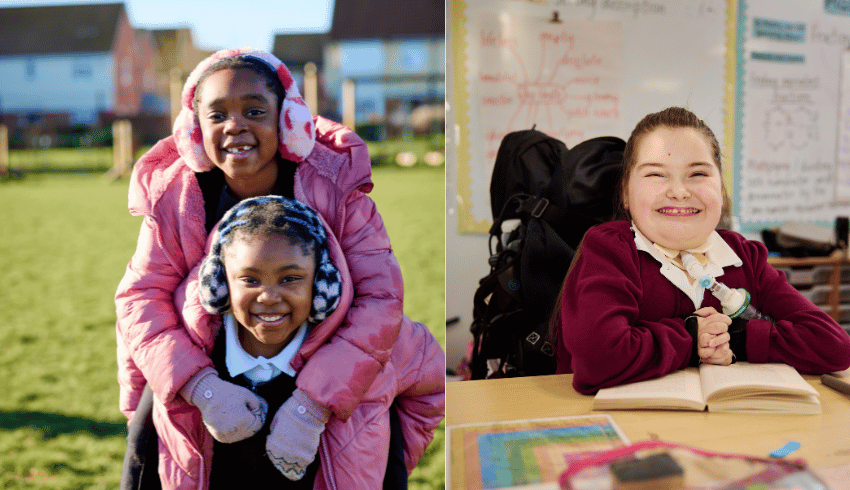
“Because our teachers are highly skilled, each one has an area they’re passionate about,” Koulla tells me. “They go out, receive training, bring it back, and improve practice”.
External training
Peer reviewers receive external training on an area the school would like to improve upon, or develop, such as oracy, then come back and deliver it to other teachers in their school.
This allows each setting to get the most out of each external training session, and make sure all staff have equal access to knowledge.
The programme also includes every member of classroom staff, whether they’re teachers, leaders or LSAs. “Everyone has a professional development pathway,” says Koulla.
But it’s not one-size-fits all; each pathway is relevant to a particular role, and tailored to staff’s particular desires for progression.
“As an example,” says Koulla, “we have a one-to-one SEND LSA who supports a child with visual impairment. She will receive a very different pathway from somebody who is a one-to-one SEND LSA for a pupil with ADHD.
“Some teachers are on the ECF, some are training to be peer reviewers or improvement champions, some are doing NPQs. There’s a lot going on.”
Peer review
So, what does peer review look like at Lakelands Primary? At the start of every year, leadership teams in each school in the MAT identify staff who could become peer reviewers or improvement champions.
Many have progressed through the system over the years, Mark explains, and then they receive training, using a shared framework across the Trust.
The framework is made up of pillars – assessment, engagement, creativity, and adaptation – and each school in the Trust can adapt it to suit their context; but because everyone uses the same vocabulary and expectations, feedback is clear and effective.
“Each school chooses when its peer review happens,” Mark says. “We chose June, so findings can feed into our school improvement plan for the following academic year.”
“It’s a three-step process,” Mark continues. “There’s a coaching session for peer reviewers two weeks before the review is planned to happen in school, for us to clarify the focus and what evidence we need to gather.”
The next step, he says, is the peer review day itself, “where we visit lessons, speak to staff and pupils, and gather our evidence,” then three months later, staff receive a follow-up coaching session, to review the impact of the training and identify next steps.
Each school sets an inquiry question – “To what extent does…?” – which gives peer reviewers a clear focus. After the review, findings go to the improvement champions, who design a CPD session based on them for the rest of the staff.
“We’re currently consulting on what good adaptation looks like, so that’s the focus for this year,” says Mark, “and another challenge is to make sure the framework and training remain fit for purpose.”
Structured training
A lot goes into this continuous professional development, but it does make larger changes easier on the Trust, Mark explains.
“Because we have the framework, with agreed language and structure, things like the new curriculum review are smoother for us, because we relay them in previously agreed upon terms, so everyone’s on the same page.”
There’s also a sense of support that comes with structured training, says Mark, and not only for the job day-to-day, but also for career progression.
“I’m new to the role of teaching and learning lead, but I feel supported with the great training we get. Because it’s cyclical and I can then pass it on to colleagues, it reinforces and solidifies what I’ve learned, which is really helpful, as then I know I’m fully equipped to do my job,” he says.
Monitoring
Once training has been disseminated, a process of monitoring follows. For example, “on our next inset day, I’ll be leading a session about questioning,” explains Mark.
“We’ll then be able to monitor that across the school, looking at how it applies across the curriculum in all Key Stages.”
The monitoring process also allows teachers to make on-the-spot adjustments, adds Koulla, and because the structure has been clear from the start, teachers are receptive to feedback when peer reviewers do monitoring sessions in classrooms.
But does this classroom monitoring put children off? “Absolutely not,” says Koulla, “again, because we’ve been able to mould the school from the ground up, we do one-to-one tours for prospective pupils and their families, which means we’re in and out of classrooms all the time as the school has been building up its roll, so the children are used to seeing us, and don’t blink an eye.”
- Lakelands Primary not only runs CPD for its staff, but is also involved in extra-curricular programmes to support pupils’ wellbeing and personal development, such as OPAL (outdoor play and learning), and No Outsiders.
- “The world we live in today can be pretty divided,” says Laura Herbert, class teacher and lead of the No Outsiders programme at Lakelands.
- “We know that within society, people can find it difficult to communicate with each other, and that discrimination and racism are both unfortunately present.”
- The aim of No Outsiders, Laura says, is to “create an environment where children feel safe, where parents feel safe”.
- The programme is built around picturebooks, and it teaches the premise that ‘everyone is different, but all are equal’.
- “We teach key vocabulary,” says Laura, “and we include some strategies for how to deal with things like racism”.
- But the approach isn’t just academic. The principles of No Outsiders are very much woven into the fabric of the school, and Laura reports that they’ve seen positive changes in the playground.
- “We see pupils inviting those who are on their own into their groups to play,” she says, “and they’re using the vocabulary they’ve learned to be welcoming to their peers”.
- Ultimately, Laura says, it’s about everybody being able to be themselves, whatever form that may take.
- “It goes back to empowerment,” she says. “If we can all support each other, even in our differences, then school – and the world – will be a better place.”
Onwards and upwards
But what about impact? What areas of improvement has Lakelands seen in the short time it’s been open? Koulla explains that arithmetic has been a big focus, and that this has paid dividends across the school.
“We’ve worked really hard on arithmetic,” she says, “we found that was something a lot of our children needed a bit of support with.”
But, she explains, when you start developing one skill, it does end up tying into the rest of the curriculum as well.
“As the children are growing through the school, obviously their needs change,” she explains, “so with the focus on arithmetic has come a development of multiplication and division skills. We’ve then moved on to mathematical thinking, and how we are getting the children to be able to reason and problem-solve, how they can use those skills not just as an extension task, but throughout their maths.”
And so it goes: mathematical thinking and problem-solving feed into vocabulary and sentence structure, respectful discussion and evidence-based explanation, all of which are essential skills across the curriculum.
Curriculum design
All this supports overall curriculum design, too, as the school has an overview of all teaching across each year group, documenting how each unit links to others, and where callbacks are relevant.
This is provided to teachers so that they can seamlessly weave in retrieval tasks – not only from the children’s current year, but from across their schooling – to create strong knowledge links, bolstering the knowledge-led curriculum.
And again, there is CPD available to support teachers’ own curriculum knowledge. “Every member of staff has a particular interest,” says Koulla, “so we do what we can to allow them to follow those passions”.
Essentially, the aim is for all teachers at Lakelands Primary to be a specialist in their chosen area – whether that’s history or wellbeing – and give them the skills to pass their knowledge and passion on to others across the school, and in some cases, the Trust.
The iterative nature of the CPD cycle also allows teachers to benefit from the kind of teaching they give their pupils – as new research is done, and goals are developed, the framework is adapted.
As the curriculum encourages retrieval and continuous development, so does the training and coaching for teachers.
There’s a community feel at Lakelands – all for one and one for all. There’s an understanding amongst staff that they will support one another, and in turn benefit from that support themselves.
“It’s about empowering teachers,” says Koulla, “then giving them the skills to empower others”. And isn’t that what education’s all about?
Meet the staff
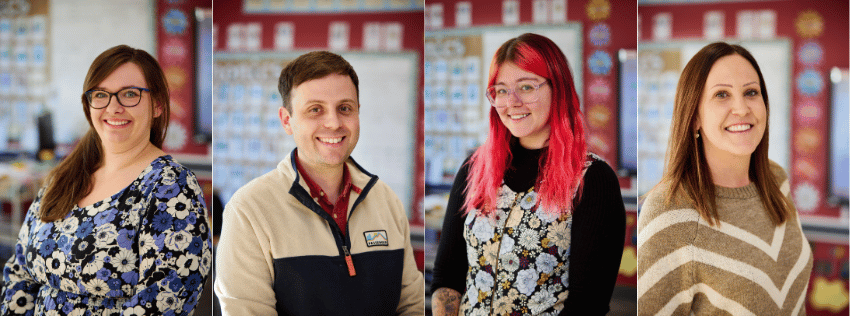
Laura Herbert, class teacher and No Outsiders lead
Being able to empower people to be confident is wonderful. And to see the positive effects of No Outsiders has been really lovely.
But thanks to the training, I also have more confidence to openly have important conversations with members of our community.
Mark Shean, class teacher and teaching and learning lead
Ordinary lesson observation can be really stressful, and it’s easy to overprepare and then not run a lesson as you normally would. But peer review is more of a reflection of natural practice, than a performance.
Daisy Stone, LSA and ELSA
The CPD has been fantastic, because the leadership is so open to what interests you. Alongside my emotional literacy work, I’m really interested in drawing and talking. So SLT has put money aside for me to go on a course.
Danielle Llewellyn, assistant headteacher and OPAL lead
We used to have quite a few problems at playtime and lunchtime, but since starting the OPAL programme, we’ve had barely any issues. We really value play at Lakelands Primary, so it works well for us.
Meet the pupils
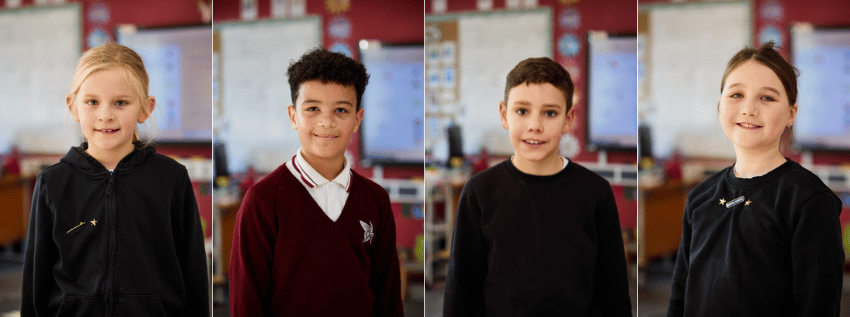
Millie, Y4
We’re play leaders, which means we help set up all the OPAL stuff at playtime. We want to do an assembly thanking all the adults that help with OPAL.
Dominic, Y5
Being a play leader is great, but can be a little bit stressful, because if something happens, you want to try and resolve the problem.
Samuel, Y4
Miss Llewellyn taught us what we can say and do when someone’s having a disagreement on the playground, to try and help.
Lola, Y4
We come outside early at playtime and lunchtime to help set up all the equipment, and let the adults know if anything is broken or not working properly.