


Debating – Is there a more nuanced way to exchange views?
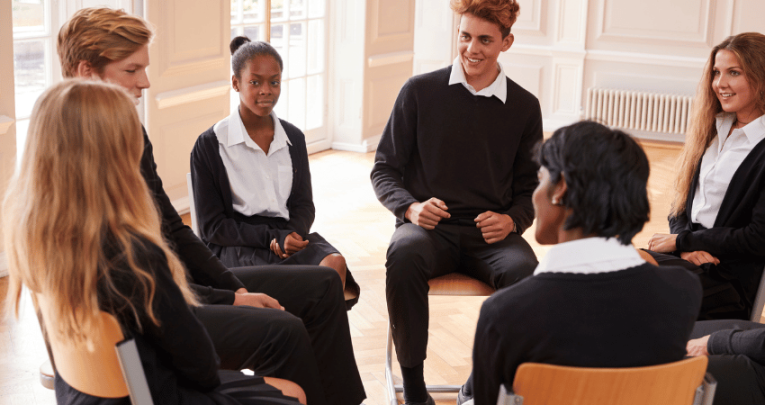
The cut and thrust of traditional, Oxford-style debating has its place, and can equip you with some useful skills – but if we’re to meet the demands of the modern age, we’ll need a less adversarial way of exchanging ideas…

I signed up for debate club at school and went on to become county champion, and later chair of my university’s debating society.
‘Oxford Union-style’ debating, which was the type I learned, is still considered the pinnacle of the form in most schools.
Competitors are given just a few minutes to come up with a compelling argument based on a vague ‘motion’ (‘This House believes…’) which they get to define. However, there’s no necessity for teams to believe the things they’re arguing.
The winners will usually be those who present their thoughts with the most panache. And as I know from having participated in many such events, you get massive bonus points if you’re funny.
No one thinks all that deeply about what they’re saying. And no one actually considers whether the opposition might be making some valid points. The whole thing feels more like an intellectual game of tennis than a meaningful discussion.
You do learn some useful skills, though. As a girl from a working-class family, debating gave me many tools that helped me to progress in life.
It sharpened my ability to think on my feet and explain myself clearly. It improved my confidence, and also got me noticed by the kind of posh people who had useful connections.
‘Gotcha’ moments
Then again, I didn’t go to school in the era of social media, where some of the most successful influencers’ shtick revolves around ‘owning’ and humiliating others.
In fact, it could be argued that most internet discourse is an exercise in who can shout the loudest. This is rather than listening to and understanding others’ perspectives.
There’s a clear line that links Oxford Union-style debating clubs with social media. ‘Gotchas’ gain more traction than the sharing of insightful or valuable information.
It’s a mode of communication that turns us all into caricatures of ourselves, standing for or (more likely) against something, while never acknowledging any complexity or nuance.
Without wanting to sound too dramatic, this has the potential to ruin society, humanity and the world. In an increasingly hostile and polarised age, we must find better ways of communicating.
Whilst writing my latest book, I spoke to Jane Ball – founder and trustee of the Academy of Professional Dialogue.
Jane has spent decades taking a technique she developed with colleagues – simply called ‘Dialogue’ – into prisons, as well as commercial and social settings. She’s now focused on bringing it to schools.
Thinking collectively
We discussed debating, and Jane agreed that traditional ways of teaching it weren’t all that useful in the context of modern society.
The idea behind Dialogue is to encourage groups of people to actively listen to each other, and respect and value each other’s perspectives. This is so that they can ‘think collectively’.
When incorporated into classroom practice, Dialogue aims to connect each individual child and their lived experience with the learning material on the curriculum.
As well as expression and voice, it’s also about ‘noticing’ Jane says. She told me about a practice called ‘suspension’. The idea is that we take our view, and then, rather than connecting our identity with the idea that we’re right and other people are wrong, we ‘suspend’ it.
In suspending, we can examine our view more closely, from all angles. This means we hopefully notice its flaws ourselves, rather than have them pointed out to us.
In an era when children are learning from toxic influencers that shouting over each other is something to aspire to; that pithy catchphrases are more important than thought-out positions; that respecting one another is optional – it might now be time to start swapping debate for dialogue.
Natasha Devon is a writer, broadcaster and campaigner on issues relating to education and mental health.