
Confidence Boost – LEGO’s Role In Supporting Disadvantaged Pupils In Essex
Linda Oliffe, business manager at Felmore Primary School in Basildon, explains how using hands-on resources as part of a mentoring intervention project has helped to improve the attainment of disadvantaged pupils across Essex

- by Linda Oliffe
Since being rated ‘Good’ by Ofsted in 2014, we have worked hard at Felmore Primary School to continue supporting our pupils’ social and academic achievement.
We’re always on the lookout for ways to promote innovative teaching and help pupils develop not only academically, but also socially. As part of this, we decided to take part in an ongoing project that specifically focuses on disadvantaged pupils in 27 schools across Essex.
The project
The project is run as a breakfast club and aims to help boost attainment and engagement levels for those who currently struggle – in particular, looked after children (LAC). The DfE has found that LAC pupils tend not to perform as well as their peers, and while this isn’t the case for every individual, they often also struggle with attendance, attainment, and emotional literacy.
As a result, they can become disengaged, switch off and thus fall behind in lessons.
Closing the gap
We wanted to close this gap, and believed that getting pupils involved in more physical activities relating to subjects like literacy, maths and science may be the answer. Not only that, our LAC had poor communication and emotional literacy skills too, which meant they found it incredibly hard to open up and express themselves.
Hosting the breakfast club meant we were able to provide them with a safe environment away from the classroom, giving them the opportunity to explore their emotions and better develop their existing skills.
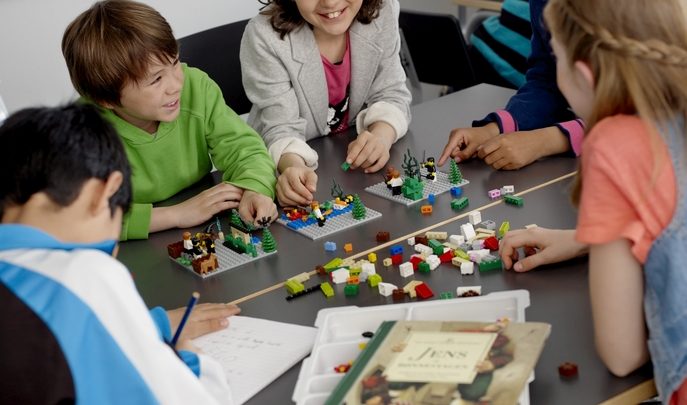
We used a mentoring intervention to build scenes using LEGO® Education resources, including StoryStarter, BuildToExpress and MoreToMaths. Some scenarios were completely made-up, while others related to actual situations the children had encountered.
Creating these models gave them the chance to really think about how they felt and how certain aspects impacted their emotions. From this, we were then able to talk about difficult situations, and develop strategies to help the children cope with them.
The successes
We assessed the children before the start of the project, and then studied their Age Related Expectations (ARE) after the project had been running for two terms.
The findings were remarkable. Initially, only 9.1% of the children had working at their ARE for literacy and 13.6% for maths. By the end of term, however, these proportions rose to 31.8% for literacy and 27.2% for maths.
Those statistics might be strong, but it’s the noticeable difference in the children themselves which pleases us the most. Our pupils have developed greater focus during lesson time and built up considerable amounts of confidence. For example, we have one pupil who previously stuttered with his speech. Since being involved in the project, he can now coherently tell his stories without any hesitation. Another of our pupils with moderate learning difficulties is now able to verbalise ideas.
Attendance rates have improved as well. One carer reported that he simply couldn’t get the pupil to attend school; since the project, the pupil has attended every day.
What’s next?
Despite only committing to the project for two terms, it has surpassed our expectations. We’re now continuing with it, and have around 80 pupils split between two breakfast clubs.
It’s definitely helped to improve the engagement, attainment and confidence of our pupils, with the children involved now arriving at lessons eager to learn.
We appreciate that what works for one pupil may not necessarily work for another, especially if they struggle with emotional literacy. This project gave us an alternative avenue to try, and we’re continuing to reap the rewards!
Further details about Felmore Primary School can be found by visiting www.felmore-pri.essex.sch.uk or following @FelmorePrimary
For more information about LEGO Education UK and its education resources, visit legoeducation.co.uk or follow @legoeducationuk