


Year 11 – How schools can keep the stress at bay

Katharine Radice shares with us her advice on what schools can do to help their Y11 students navigate the crucial final year of their schooling…

- by Katharine Radice
- Author, teacher and education consultant Visit website
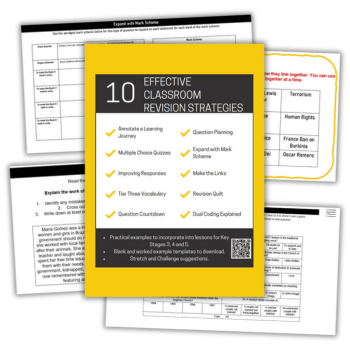
Year 11 classroom strategies
Focus on the now – the rest comes later
When teaching Year 11 pupils in September, should we be highlighting what they need to think about now, while simultaneously telling them about what they should keep an eye on in six to eight months’ time?
There’s a difference between teaching to the test and talking to the test. Do we really have to mention exams as much as we do?
The more we encourage students to think about both what’s important today and this unknown future, the more unmanageable their preparations will likely start to feel.
Students have less time than you think
A fundamental difficulty when revising for GCSEs is the lack of time. If you were to calculate the number of revision hours available to our students, factoring in weekends and holidays, and divide that by the eight to ten subjects most students will be taking, you’ll quickly see just how limited their time really is.
A big challenge for Year 11 students is how many revision tools are available to them, but they don’t have any more time to sift through then than previous generations of students.
This can make devising a revision plan actually harder. Deciding what they’re not going to do has now become as important as deciding what they are going to do.
That’s why it can be helpful for students to talk through their priorities with you in a way that’s realistically calibrated to how much time they have. ‘Miss, I’ve got 2 hours to revise this topic, so I thought I’d do [X] – is that sensible?’
Be mindful of other subject demands
Teachers need to consider, realistically, how much time students have to revise their subject. When will they do that revision?
If you stop and really think about how many hours students will be able to dedicate to revising your subject over, say, the Easter break, you’ll likely find yourself shocked at just how small that number actually is.
Again, remember that students have far less time to revise than we, as teachers, often realise. That can lead to gaps between what teachers believe their students can do, and the reality of what’s going to be possible for them to do.
The bigger those gaps become, the higher students’ stress levels will be.
Use past papers strategically
Past papers can make exams feel more familiar and less intimidating, and are essential for developing exam technique.
That said, completing past papers is a summative task that requires students to practise using knowledge. They’re not necessarily the best way of building that knowledge.
Come the day of the exam, students will need to have been working with past papers for a certain amount of time. However, that doesn’t necessarily mean they should be using them from the start of Year 11.
Introduce them too early, before students have the knowledge and skills needed to properly access the questions, and you run the risk of making the exam seem more complicated and difficult than it actually is.
Whole-school strategies to help Year 11
Emphasise that stress responses are natural
When we talk about exam stress in school more generally, many students can lapse into thinking that it’s possible to experience no stress at all. Or they may dwell on the stress they’re feeling to the point that it becomes unmanageable and overwhelming.
The sweet spot is for students to adopt a healthy, realistic perspective of what’s normal and natural for them to be experiencing.
We should acknowledge that it’s natural to feel slightly queasy when an exam’s about to start. They may have difficulty sleeping well the night before.
Accepting this can help us develop workable strategies for dealing with that stress when it presents itself.
Celebrate with care
There’s a place for celebrating great work at a school-wide level – students’ GCSE art displays being an obvious example.
However, we should also remember that the purpose of exams is to divide and rank students according to the perceived quality of their work.
If your school only celebrates your students’ very best work, you’re establishing a specific quality marker against which everyone will feel encouraged to judge their own work – and how far it is from meeting that standard.
As adults, we know that how good someone is at maths doesn’t define them as a person. And yet, right now, your Year 11 students are being graded and marked on their performance in different subjects via methods that are quantified and highly visible – but which won’t be used to measure, for example, their kindness or resilience.
So even when exams are looming, make sure there’s some celebration of school-based achievements that aren’t just related to grades.
Peer interactions
Often, the advice students value most will tend to come from their peers. Make room for your Year 11 pupils (and Y12s, if applicable) to share how they’ve managed the revision process themselves.
What are their tips on how to take restorative breaks? How did they set themselves manageable targets?
Staff will want to review and check the advice given first, of course. But that kind of wisdom can be really helpful for students to hear from others who have gone through it themselves.
Advice for parents of Year 11
Children can tell us what they need
When working with parents on issues relating to exam stress, I’ve often said that the best advice they can get on how to support their child will come from the child themselves. They’re the ones actually living it.
Parents should understand that their role isn’t to just ‘support their child’s revision’. It’s to help them with the process of managing medium- to low-level stress over time.
This means making sure their child gets enough rest and has things to look forward to. It’s unhealthy for a child to be thinking about exams all the time.
Parents also need to be alert for acute stress, know how to help their child with this, and where to go for professional medical/therapeutic support if it’s needed.
Familiarise parents with the process
Staff in schools are now much more alert and attentive to following up on serious wellbeing concerns than in years gone by. They should be justly proud of their work in this area.
Another area that perhaps needs to be thought about more, however, is what schools can do to help parents understand what the GCSE process involves.
Staff can be naturally wary of transgressing into ‘telling parents how to parent’. However, bear in mind that secondary schooling can often be virtually invisible to most parents.
This is partly because most teens don’t want to talk about school at home. But also because parents’ perceptions can be distorted by memories of their own schooldays.
Some parents may have attended the very same school as their child, been taught in the same buildings and sat exams in same subjects. But the exam experience for a Y11 today will be radically different from that of 20 or 30 years ago.
If schools don’t help parents understand what it’s like today, it becomes harder for them to know how they can help.
Schools are limited in what they can do
Many schools now offer webinars or after-school presentations aimed at informing parents about the procedures and processes surrounding exams.
Whatever parental communication method you use, be aware that there’s real value in thinking about what parents need to understand, and what they presently might not.
Different teenagers will go through school with wildly differing levels of parental support. This itself may be highly variable in terms of how effective it is.
Schools can’t simply wave a magic wand and have every parent do as every parent should – but the more clearly a school can describe what effective support looks like, the easier it will be for parents to move in that direction
Katharine Radice is an author, teacher and education consultant, currently teaching part-time at both a mixed-ability comprehensive school and at Gonville & Caius College, Cambridge. She regularly runs workshops for students, teachers and parents on exam stress. Her book, The Parents’ Guide to Exam Stress, is due for publication in March 2026