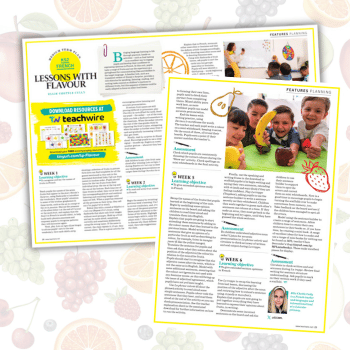



Bringing language learning to life through practical, hands-on activities – such as food tasting – is an excellent way to engage pupils and develop their confidence in expressing opinions in French. In this unit, pupils taste a range of fruits and use the experience as a springboard for communicating likes and dislikes in French.
A familiar text, such as a translated version of Handa’s Surprise, provides a rich stimulus for speaking, listening, reading, and writing tasks centred on children’s reactions to different fruits, but this sequence of lessons could be easily adapted to focus on other food items.
Learning objectives
- Recognise and say the names of fruits in French
- Read and write fruit names in French
- Give simple opinions orally in French
- Recognise, say and spell the names of colours in French
- Give extended opinions orally in French
- Give extended written opinions in French
First lesson
Teach pupils the names of the seven fruits that appear in the story Handa’s Surprise, using flashcards to introduce the vocabulary.
Draw pupils’ attention to some of the trickier graphemes in these words, such as the an in orange or the on in passion. Discuss the presence of the silent letter t at the end of l’avocat or the word fruit, and explain that the final t in French is usually silent, to help build early phonics awareness and empower pupils to recognise patterns they will encounter again.
French fruit games
Next, play Loto en ligne (Line bingo) to attune pupils’ ears to the new vocabulary. Give each child a strip showing a selection of fruits in picture form (find templates for all the games mentioned in this unit in this download).
Call out fruit names in random order. Pupils should listen for the two fruits from their individual strip: the one at the top and the one at the bottom.
Each time one of their fruits is called, they cut or tear off the corresponding picture and continue listening and removing images until none are left. When a pupil has removed all the pictures on their strip, they call out J’ai gagné! (I’ve won!).
Follow this with a round of Répétez si c’est vrai (Repeat if it’s true), using flashcards that show only fruit images without word prompts.
Hold up a fruit and say its name aloud, sometimes correctly and sometimes deliberately using the wrong name.
If the name is correct, the class repeats it; if not, they remain silent. This is a great activity for encouraging active listening and accurate pronunciation.
If certain fruit names are still proving difficult to pronounce, play Cherchez la carte (Find the card). Send one pupil – the seeker – out of the room while you hide a flashcard somewhere in the classroom.
When the seeker returns, the rest of the class guides them by repeating the fruit’s name, whispering when the seeker is further away from the card and gradually increasing volume as they get closer.
Finally, read La surprise de Handa aloud. Encourage pupils to use a simple signal – thumbs up, fingers on noses, or another gesture – whenever they hear a fruit name.
Ellie Chettle Cully is a French teacher and languages and international lead at a Leicester primary.