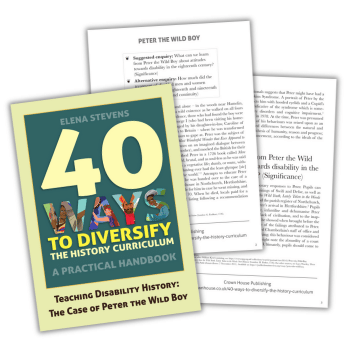


This free sample chapter comes from the book 40 Ways to Diversify the History Curriculum by Elena Stevens and focuses on the case of Peter the Wild Boy. Use it to help you make history teaching more inclusive by focusing on how people perceived and represented disability throughout different historical periods.
What is the chapter about?
The chapter follows the story of Peter the Wild Boy. People found him living alone in the woods near Hanover in 1725. King George I later brought him to England.
Pupils will explore attitudes towards disability in the 18th century. At the time, people treated Peter’s unusual behaviour and inability to speak as signs of “wildness” rather than disability.
He was displayed at court as a curiosity. This reflected the era’s fascination with the “other” and its limited understanding of mental and physical differences.
Modern historians now believe Peter likely had Pitt-Hopkins Syndrome, a genetic condition linked to learning and communication difficulties and distinctive facial features.
Teaching disability history with Peter the Wild Boy
The chapter suggests enquiry-based lessons around questions like:
- What can we learn from Peter the Wild Boy about attitudes towards disability in the 18th century?
- How much did the treatment of disabled men and women change during the 18th and 19th centuries?
Encourage students to:
- Analyse primary sources such as writings by Jonathan Swift and Daniel Defoe that dehumanised Peter.
- Compare historical attitudes with today’s understanding of disability.
- Explore broader examples of 18th-century disability experiences – such as the work of the Foundling Hospital or disabled artists like Sampson Towgood Roch.
Why teach this during Disability History Month?
- Disability History Month is the perfect time to highlight how disabled people were misunderstood, marginalised and sometimes exploited in history.
- This chapter encourages pupils to critically examine bias and representation, recognising how concepts like “normality” and “progress” were shaped by exclusion.
- It positions disability as a core part of social history, not a side topic, helping make the curriculum genuinely representative.
- It humanises disability history by focusing on a single story that reveals wider social attitudes.
Elena Stevens is a secondary school teacher and the history lead in her department. Her book 40 Ways to Diversify the History Curriculum is a practical, wide-ranging compendium of enquiries and case studies to help you diversify, reimagine and decolonise your history curriculum.