


School bell – Get rid of it and give teachers flexibility
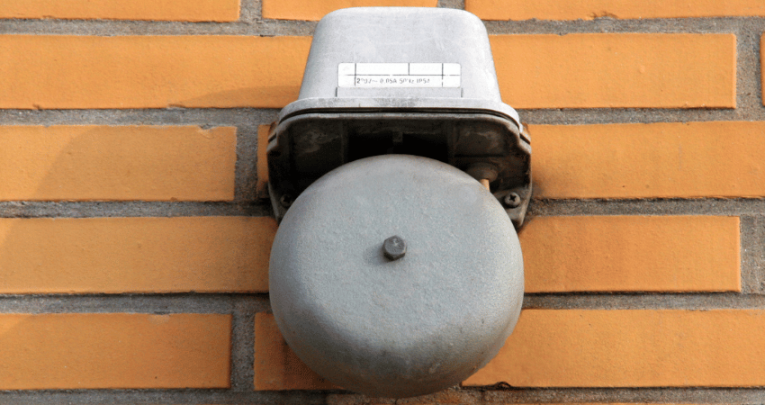
If he had his way, Gordon Cairns would sound the death knell for those rude, school-wide blasts of disruptive noise that signal the end of one period and the start of the next…

- by Gordon Cairns
- English and forest school teacher
Isn’t it bizarre that we teachers choose to expose ourselves to the brutal noise of the school bell multiple times over the course of a typical workday?
Not to alert us to a terrorist attack or national disaster, mind you. Just to let everyone know when it’s time to transition from one place to another.
Unnecessary distress
The school bell is a remnant from when timepieces weren’t readily available to the general population. Schools needed a method of mustering their students, similar to how churches still ring out to summon their parishioners.
But today, regularly interrupting the school day with a loud, toneless sound feels so unnecessary. It’s also unnecessarily distressing to those many neurodiverse students who are sensitive to noise.
Young people already struggling to overcome many barriers to education don’t need an extra sonic one. I know of students who have to leave the classroom before the school bell goes to find a quiet space.
“It’s also unnecessarily distressing to those many neurodiverse students who are sensitive to noise”
Others will put on ear defenders in anticipation of the end of the period. Many more suffer in silence, their focus lost as they anticipate the aural assault and think about how to deal with its aftermath.
A question of trust
For the school community as a whole, this all feels a bit reductionist. The school bell seems to suggest that we, much like Pavlov’s salivating dogs, can be trained to perform desired reactions simply by hearing a loud sound.
This is despite being surrounded by more than enough timekeeping technology to know exactly when our lesson is just about to finish.
Maybe SLT’s fear is that they can’t trust us to end our classes at the appropriate time without some kind of centralised notification system.
Segmenting out the day into time slots abbreviated by the school bell was apparently once done to prepare students for factory life. However, they won’t be encountering bells anywhere in their working future.
Unless they become teachers, of course.
“Maybe SLT’s fear is that they can’t trust us to end our classes at the appropriate time”
In fact, the lack of a school bell would do far more to prepare them for today’s working environment. After all, employers don’t generally break down the amount of time given to an activity into alarm-delineated chunks.
Classroom flexibility
The dead hand of tradition aside, there seem to be few good reasons for keeping the school bell around. Changing the system would simply involve us educationalists synchronising our classroom clocks (or watches, phones, tablets or PCs) so that we know when to dismiss our students.
After all, it’s not as if they currently arrive en masse at the start of the next class just as the bell rings. There would be tangible benefits to teaching and learning too. A lack of a centralised alarm would give teachers more flexibility in the classroom.
Currently, if I want my students to finish reading the chapter of a book before the period ends, I keep one eye on the book and the other on the clock as the minute hand creeps ever closer to the ringing bell.
I know the class will have lost their focus when they hear the sound, as they think about their transition to the next class.
“A lack of a centralised alarm would give teachers more flexibility”
But if we give teachers control over ‘when the bell rings’, pupils can satisfactorily conclude their work with only a minute or so of overrun, if that.
Sixth sense
Sadly, today’s electronic buzzers are nothing like the ‘Laugh of a bell swung by a running child’, as recalled by Carol Ann Duffy in her classroom memories.
If and when silent school bells are eventually introduced, the ideal scenario would be for students and teachers alike to develop a ‘sixth sense’ that something is coming to a close, without needing a bell to remind them.
It would be akin to waking up naturally before that other unavoidably ubiquitous modern noise, the morning alarm clock.
Gordon Cairns is an English and forest school teacher who works in a unit for autistic secondary pupils. He also writes about education, society, cycling and football for a number of publications.