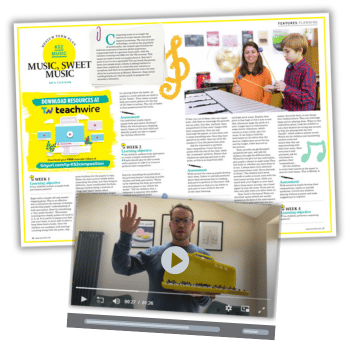

This free KS2 six-week medium-term plan about music composition introduces pupils to the creative process of making music through rhythm, body percussion and simple melodies…
Composing music is no longer the reserve of conservatoire-educated classical musicians. The rise of music technology, as well as the popularity of social media, has created opportunities for bedroom musicians to become global superstars.
Composing music is a genuine career path, with the industry creating over £6bn for the UK economy. This means we need to teach our pupils about it.
But don’t panic if you’re not a specialist! You can break the process down into simple steps. Nobody is asking teachers to show their pupils how to create the next concerto or symphony and there is no expectation for every six-year-old to be as precocious as Mozart.
However, these initial building blocks are vital for pupils to progress into secondary education.
Music composition KS2 learning objectives
- Imitate a simple body percussion pattern
- Combine body percussion to create a simple composition
- Work with a partner to take it in turns to perform their composition
- Combine four notes to create a simple melody
- Perform a repeating pattern
- Practise their composition
- Perform their composition to an audience
Example videos
Click to watch ten videos of teacher Ben Connor demonstrating elements of this medium-term plan.
Starter activity
Begin with a simple call-and-answer clapping game. This is an effective way to introduce the concept of rhythm and develop pupils’ understanding of body percussion.
Start by introducing a ‘four-pulse rhythm’. This means counting four steady pulses out loud (1, 2, 3, 4). It is useful to stamp your feet, nod your head, or move side to side to keep these beats steady.
Once the children are confident with moving/counting along with the pulse, clap some rhythms for the pupils to copy. These can start as four steady beats, mimicking the pulse, but then bring in different, more complicated rhythms.
Discuss rhythm being a mixture of ‘long’ and ‘short’ beats; when clapping, this means leaving a longer gap between claps.
For example, start with four long beats (1, 2, 3, 4) and then mix in some shorter beats (1 and 2 and 3 and 4 and), etc.
Assess whether the majority of the class is comfortable copying these. If this is the case, expand the rhythms to including other body percussion rather than just clapping. Use knee taps, foot stomps, chest taps, or even cheek taps to make different rhythms.
If you want to extend the learning, try playing follow the leader: sit pupils in a circle and ask one child to be the ‘leader’. They create a simple body percussion pattern for the rest of the class to imitate. The role of leader is then passed around the circle.
Ben Connor is a deputy headteacher at a primary school in Bury, Greater Manchester. He is a trained music specialist and has been teaching for 13 years in various schools.