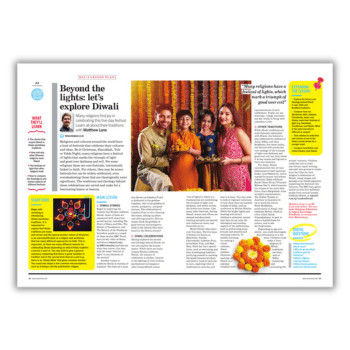



PDF lesson plan
KS1, KS2
Years 1-6
Be it Christmas, Hanukkah, Yule or Yalda Night, many religions have a festival of lights that marks the triumph of light and good over darkness and evil.
For some religions these are core festivals, intrinsically linked to faith. For others, they may be minor festivals but can be widely celebrated, even overshadowing those that are theologically more significant.
The traditions and theology behind these celebrations are varied and make for a fascinating lesson or lessons.
Festivals of light learning objectives
- Learn the stories that inspire Diwali in Hindu worldview traditions
- Find out how and why other Dharmic religions mark Diwali
- Research the festivals of light that other religions hold
- Compare the theological and human aspects of different festivals of light
Starter activity
Begin with revisiting or introducing Hindu worldview traditions. It is important to explain that Hindu traditions are many and varied, and the typical Western notion of Hinduism is an oversimplification of a religion and worldview that has many different approaches to faith.
This is important, as there are many different reasons for celebrating Diwali depending on which Hindu tradition a person is part of.
You may wish to give a general summary, explaining that there is great variation in tradition and in the sacred texts that are used (e.g. there is no ‘Hindu Bible’ that gives common stories).
You could also dispel a few common misconceptions, such as it being a strictly polytheistic religion.
Matthew Lane is an RE lead and author. His book, Religious Education: A Subject Knowledge Handbook, is coming soon from Bloomsbury. Browse more Diwali activities.