


If I were tasked with teaching Dickens to a class of primary-aged children, I would begin by showing them The Muppet Christmas Carol. In my humble opinion, it’s the best adaptation of the story ever made. And I’ll set Miss Piggy on anyone who says differently!
But in all seriousness, I think Dickens’ work is still eminently relevant for our young readers, and it’s just a case of teaching it in such a way that illuminates that relevance.
Let’s take one of his most famous novels, Great Expectations, as an example. The characters stay with you for life. Here’s a rare admission – the book so impressed me as a child that I actually made my parents and my friends call me Pip, in a weird kind of tribute to it.
So how would I introduce Dickens to primary-aged children in this day and age? I think I’d read them those opening chapters of Great Expectations. I’d then set some exercises to get them thinking about how Dickens made his work so enticing. Here are a few examples…
Copy-changing
Copy-changing is the art of using someone else’s words and altering them slightly to create your own version. It’s a useful tool for exploring how a writer crafts their sentences and serves as a way into the complex language used by classic authors.
Let’s take the opening two sentences of Great Expectations as an example:
My father’s family name being Pirrip, and my Christian name Philip, my infant tongue could make of both names nothing longer or more explicit than Pip. So, I called myself Pip, and came to be called Pip.
Young children’s mispronunciations often become part of family lore. Apparently, the late Queen Elizabeth II was known as ‘Gary’ because Prince William couldn’t say ‘Granny’ when he was small.
My own daughter, Grace, thought that Parma Violets sweets were called ‘Farmer Violets’ so that’s how we always refer to them in our house.
Your pupils are sure to have plenty of examples of their own, so ask them to share any stories like this from their families.
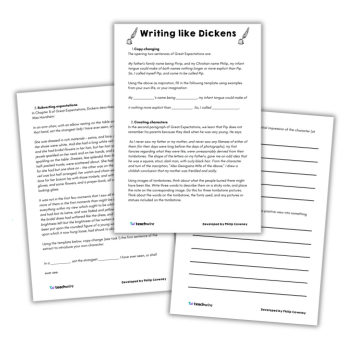
Then it’s time for them to copy-change Dickens. Using the worksheet in the download, they should replace the blanks with the details of their own experiences (or make one up, if they prefer).

Creating characters
In the second paragraph of Great Expectations, we learn that Pip does not remember his parents because they died when he was very young.
He spends a lot of time in the graveyard looking at their tombstones, imagining what they were like (find the relevant extract in the download).
For this task, you will need to find images of old tombstones to display in your classroom. I would suggest at least ten different images; a quick internet search should turn up plenty.
You will also need sticky notes for your pupils (three each). First, children should choose three of the images and, using a separate sticky note for each tombstone, write down three adjectives to describe the person they imagine is buried there.
Guide them to think about what’s written on the stones, as well as any fonts, images or statues used. Next, they should stick their notes to the appropriate images.
Now discuss their responses. Are there any images that have produced very similar responses from multiple pupils? Any that are wildly opposed? Can we really deduce anything about a person from the writing on their tombstone?
Third, children should each choose their favourite tombstone and, using the adjectives to guide them, write a paragraph about the person it commemorates, adding as much detail as possible.
Imagine the person at a particular stage of their life. How old are they? What do they look like? Do they have a job? Do they enjoy it? What are their likes and dislikes? Do they have a family? Friends? Hobbies? Are they happy? If not, why not?
Subverting expectations
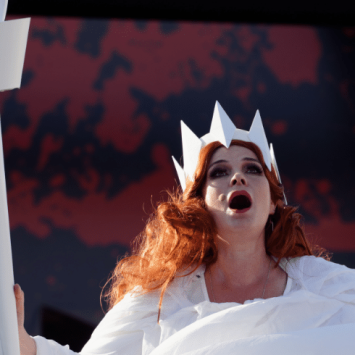
In Chapter 8 of Great Expectations, Dickens describes Pip’s first meeting with Miss Havisham. The image is one of the most famous in English literature, but why?
I think it’s because it subverts our expectations. We all know what a bride ‘should’ look like: weddings are supposed to be happy occasions; the participants are supposed to be celebrating, the dress worn once and then put away.
At first glance, this is what Pip sees – the beautiful white gown, the sparkling jewels. But, in the next paragraph, Dickens upends this image, revealing the shocking and unexpected truth that this particular bride is not what she seems.
Character descriptions
After reading this description, you should draw pupils’ attention to the structure: the description comprises two paragraphs, the first based on initial impressions and the second contradicting these.
Talk them through another example, e.g. perhaps you see Santa Claus walking towards you. However, as he gets closer, you realise that the person approaching is just a poor bearded old man wearing a shabby red duffle coat and bobble hat – and the sack over his shoulder is nothing but a bin bag full of rubbish.
Can pupils think of any other ideas like this? Once they’ve shared a few examples, it’s time for the children to try to write their own subversive character descriptions, as follows:
- Copy-change (see above) the first sentence of the extract: In a _ sat the strangest __ I have ever seen, or shall ever see.
- Write a paragraph describing the initial impression of the character (at least five sentences).
- Write a second paragraph, subverting this positive view into something more peculiar.
These exercises will hopefully go some way towards showing your pupils that just because Dickens was writing a long time ago, about places and things that might not be immediately familiar to us in the modern world, it doesn’t mean there aren’t plenty of things we can learn from this kind of classic literature. Not least, the art of the exciting story!
Philip Caveney is the author of many books for adults and children, including the Sebastian Darke novels. His book, Flipped (£7.99, Fox & Ink Books), inspired by Dickens’ Great Expectations, is out now.
Similar resources
- A Girl’s Guide to Spying – KS2 WW1 book topic
- Poetry prompts with Joseph Coelho – Author In Your Classroom ep 29
- Bring mythology into the modern world with Louie Stowell – Author In Your Classroom ep 28
- Plan an action story with Jason Rohan – Author In Your Classroom ep 27
- Collect ideas for characters with Lisa Thompson – Author In Your Classroom ep 26