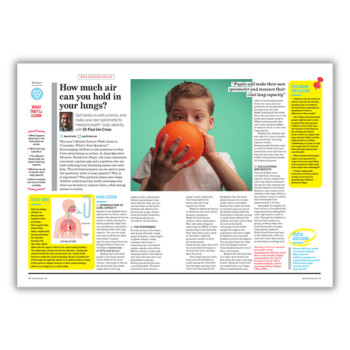


Get hands-on with science and make your own spirometer to measure pupils’ lung capacity…
Encouraging children to ask questions is what I love about being an author. In SuperQuesters Mission: Rainforest Magic, the main characters encounter a guinea pig and a capybara who are both suffering from breathing issues and need help.
This fictional scenario can be used to pose the questions:
- What is lung capacity?
- Why is it important?
This practical lesson plan helps children understand key bodily processes and what can be done to improve them, while seeing science in action.
Measuring lung capacity – learning objectives
- Understand what happens physically in the body when we exhale
- Know what vital lung capacity is
- Find out the different factors that can impact vital lung capacity
- Know what we can do to improve vital lung capacity
- Measure and record results carefully
Starter activity
Start by asking children to discuss what happens when we exhale. Once pupils have shared their ideas, explain that during exhalation the muscles between the ribs relax, which allows the rib cage to return to its usual resting position.
The diaphragm relaxes and moves upwards, causing the volume inside the chest to decrease. As a result of the pressure inside the chest increasing, the air is pushed out of the lungs through the mouth.
It is useful to share a visual at this point to support learners in their understanding, either as an image or as a short video.
Paul Ian Cross is a scientist and author of the SuperQuesters Mission books River Crest Rescue (highly commended at the Teach Primary Awards 2025), Rainforest Magic and the upcoming Desert Danger (May 2026).