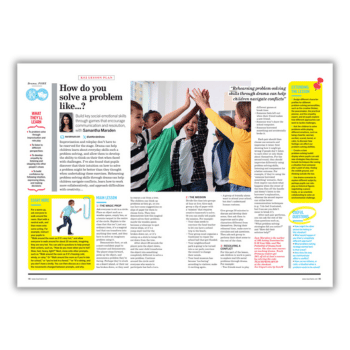



Build key social-emotional skills through problem-solving games that encourage communication and resolution…
Improvisation and role play don’t have to be reserved for the stage. Drama can help children learn about everyday skills such as problem-solving, and allow them to develop the ability to think on their feet when faced with challenges.
I’ve also found that pupils discover that their intuition on how to solve a problem might be better than they thought when undertaking these exercises.
Rehearsing problem-solving skills through drama can help children navigate conflicts, learn how to work more collaboratively, and approach difficulties with creativity.
Learning objectives
- Play problem-solving games involving improvisation and role play
- Listen to different perspectives
- Develop empathy by listening and stepping into other people’s shoes
- Build confidence by following intuition, expressing ideas and making decisions
Starter activity
For a warm-up, ask everyone to walk around the room. Start with a neutral walk, and then move onto some acting. For example, instruct your pupils to “Walk around the room as if it’s very hot,” and allow everyone to walk around for about 20 seconds, imagining they are very hot.
You can add in questions to help prompt their actions, such as, “How do you move when you’re hot? Slow, fast, heavy, light?”
Next, move onto other prompts, such as “Walk around the room as if it’s freezing cold, windy, or rainy.” Or “Walk around the room as if you’re late for school,” or “you’re lost in a forest,“ or “it’s raining, and you don’t have a brolly.”
You can then discuss as a class how the movements changed between prompts, and why.
Sam Marsden is the author of 100 Acting Exercises for 8-18 Year Olds, and The Pocketful of Drama book series. She also runs courses on teaching drama. Get 20% off all of Sam’s courses by entering the code TEACHPRIMARY20 at checkout.