


There is a vast array of themes that interlink and overlap in Shakespeare’s tragedy, Macbeth. From ‘vaulting ambition’ to guilty consciences; kingship to the ‘supernatural solicitings’, Macbeth is a play brimming with opportunities to explore a rich historical background, coupled with issues and topics that remain strikingly relevant today.
The following classroom approaches, activities and exercises will support students’ study of the play. Before exploring a work like Macbeth, however, it’s important to first ensure that students have a good grasp of the play itself in terms of its narrative, key characters and significant events.
Once their foundational knowledge of the play is secure, they’ll feel much more confident in identifying, probing at and analysing its assorted thematic complexities.
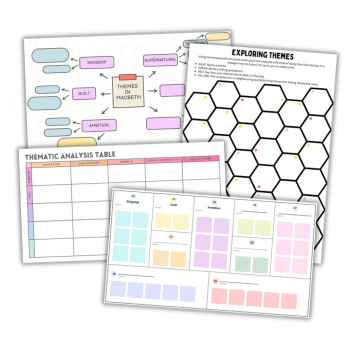
Web of themes
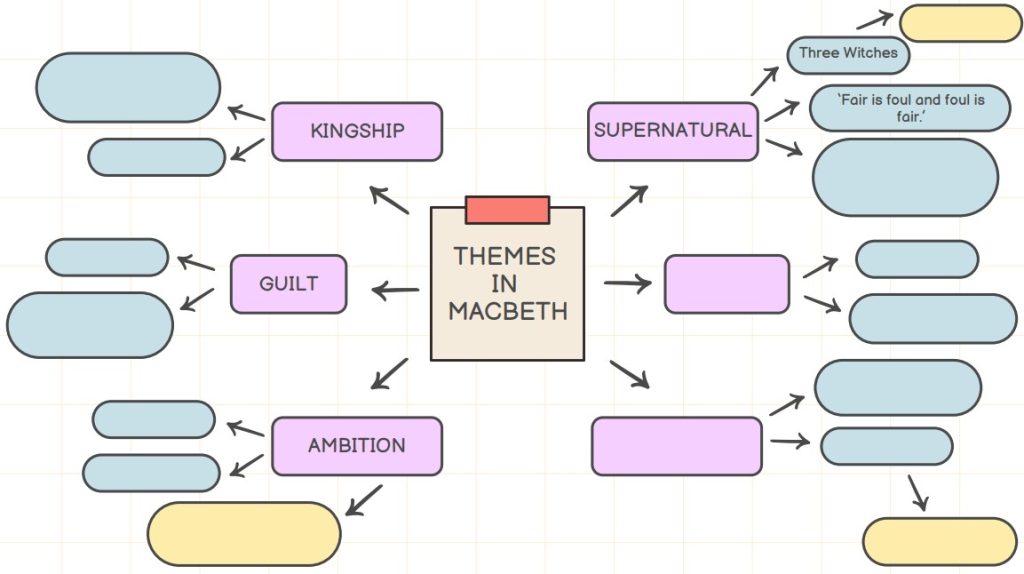
The ‘Web of Themes’ is a great way of offloading as many Macbeth themes as possible, using information from the play that links to each one.
This is, in effect, a mind-mapping activity that students can carry out individually, in pairs or in groups. It’s flexible depending on your class’ requirements.
At the end of the activity you should have a series of word bubbles arrayed in formation. These will show how different themes specifically relate to different events and characters portrayed within the play.
I use bubbles of different colours:
- lilac for overarching themes that students must identify
- blue for any initial thoughts they might have about the themes in question
- yellow for demonstrations of how a given theme appears within Macbeth
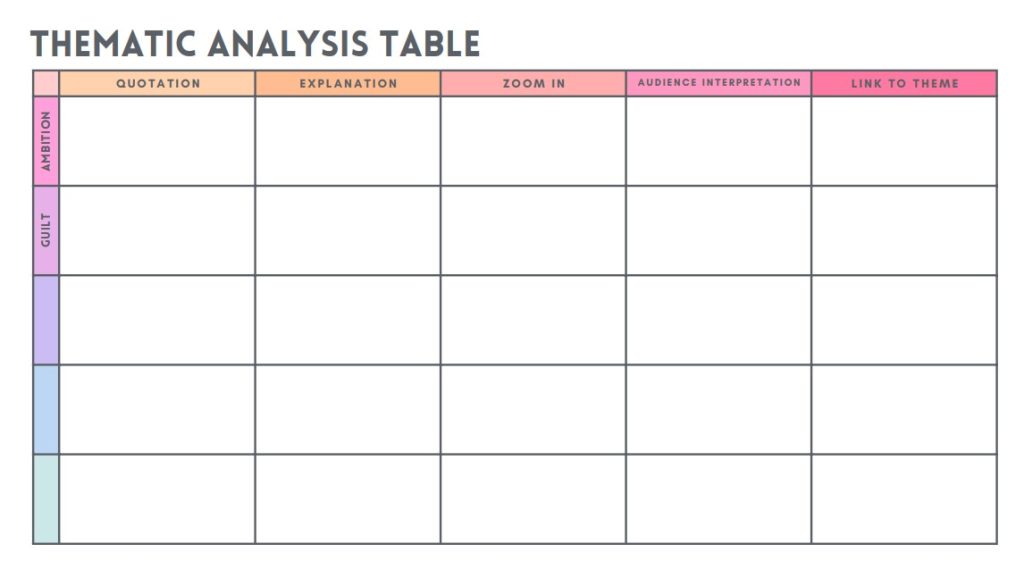
Macbeth themes grid
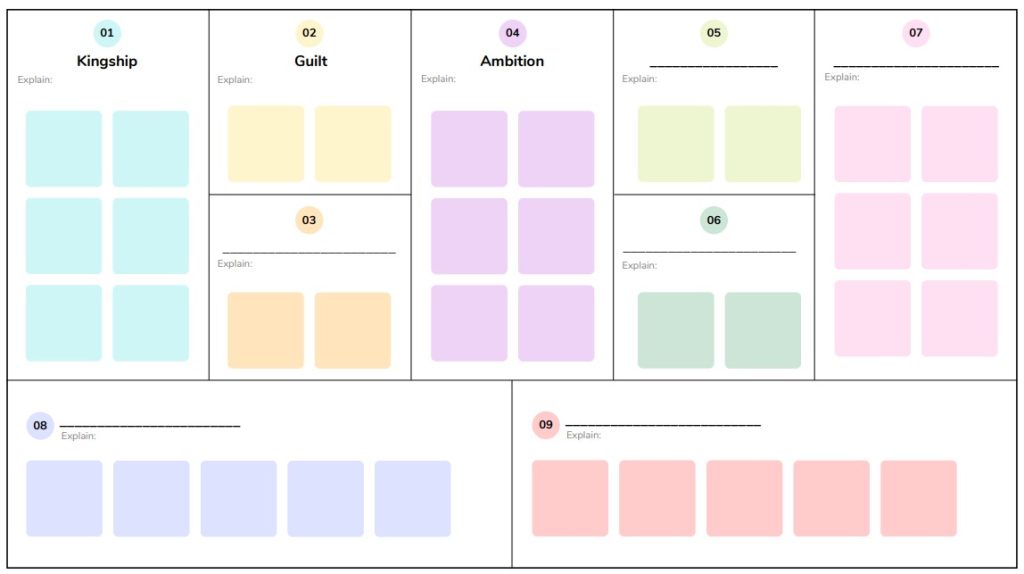
Grids can be used in multiple ways to break down key links to themes within Macbeth. They can be a great way of categorising information that will help students meet assessment objectives.
A thematic analysis table can be a wonderful revision tool for students about to embark on their exams, or even for internal assessments.
When done effectively, it can clearly show students all the key components they’ll need to know and successfully execute in the upcoming exam or assessment.
Grid-like structures can sometimes be a useful tool for helping students to simply throw all their ideas down and start organising them into key categories. In the example above, they need to break down the key themes.
Students can begin by simply writing down how those themes link to the play. They can then move on to sourcing and copying down quotations from the play that illustrate these links.
Have the students try and interrogate Shakespeare’s possible intentions when presenting the themes in question.
Flash quiz
This ‘flash quiz with a twist’ tasks students with quickly considering which themes can be linked to a specific quotation from Macbeth.
Give students a selection of 20 quotations from Macbeth, alongside a list of themes that those quotations could point to.
(For higher ability classes, you could streamline the list of themes, or not issue one at all, to give the quiz an extra level of challenge).
Here are ten quotations to help get you started:
- ‘Fair is foul, and foul is fair’
- ‘Look like th’ innocent flower, but be the serpent under’t’
- ‘Will all great Neptune’s ocean wash this blood clean from my hand?’
- ‘False face must hide what the false heart doth know’
- ‘By the pricking of my thumbs, Something wicked this way comes’
- ‘What’s done cannot be undone’
- ‘Life’s but a walking shadow, a poor player that struts and frets his hour upon the stage, and then is heard no more’
- ‘Out, out, brief candle!’
- ‘Tyrant, show thy face!’
- ‘Lesser than Macbeth, and greater’
Hive it
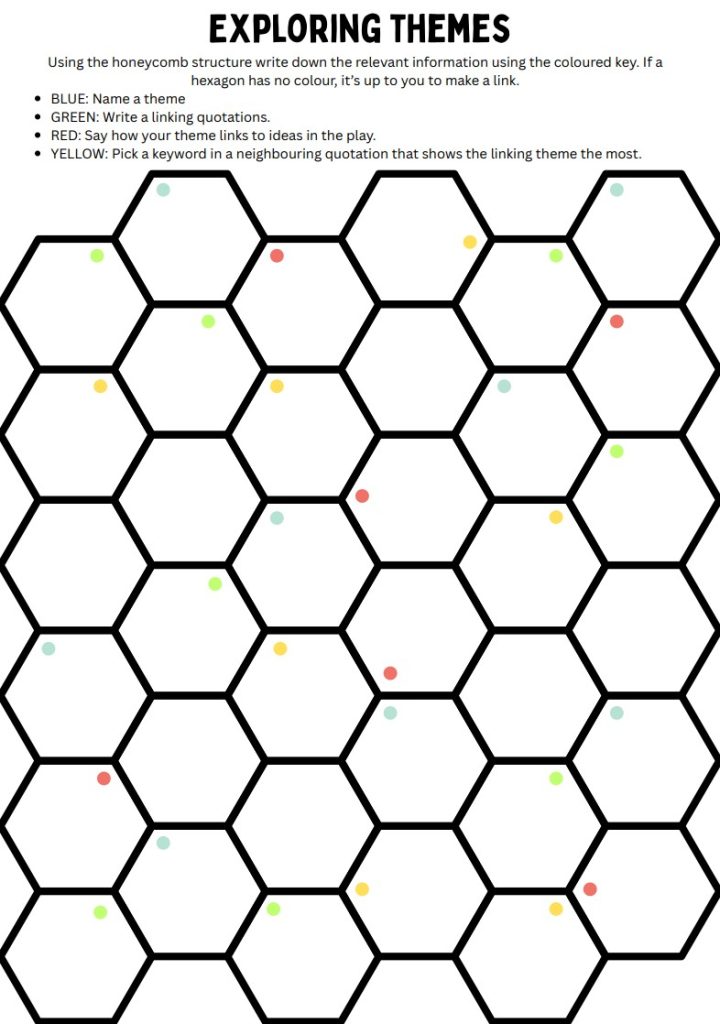
The honeycomb structure can be another useful tool for helping students organise their thoughts and ideas around Macbeth’s themes.
In this example, an arrangement of hexagons, each labelled with different colours, aims to provide students with a visual tool for mapping out their ideas:
- BLUE – A specific theme from the play
- GREEN – Write a linking quotation for the theme
- RED – Explain how the adjacent theme links to ideas in the play
- YELLOW – Pick the word from the adjacent quotation that does most to highlight the linking theme
Any hexagons left without a colour can be used to show links between different overarching themes. The task can be made more challenging by placing themes next to each other, so that students must think carefully as to which quotations can be linked to more than one theme.
This resource is a great way of challenging students to think about the how Macbeth’s different themes can overlap.
Students are likely to make multiple mistakes at first, which is why I’d encourage them to fill out their honeycomb structures in pencil to start with.
Macbeth theme presentations
These resources rely heavily on students’ reading and writing skills. However, you can also explore and encourage their oracy skills with a theme-based analysis that takes the form of a presentation.
Working in groups of four, the students assume the roles of ‘researcher’, ‘quotation finder’, ‘analyser’ and ‘magnifier’. Each group is given a specific Macbeth theme. The members carry out the following assigned tasks:
- Researcher: Suggests a number of key ideas for how the group can present their theme, drawing on the play itself and any other resources (teacher handouts, visual imagery, videos, etc.)
- Quotation finder: Locates the best quotations within the play that can support the group’s theme, with the aim of helping the group flourish in their presentation
- Analyser: Analyses the quotations found and checks them for specific links to the group’s theme.
- Magnifier: Picks out keywords from the quotations found to highlight important ideas linking to the group’s given theme
Structure and format
Once the groups have completed their tasks, they can deliver their presentations by following a set structure and format:
- Theme overview
- Quotation 1 – how does this quotation link to the theme? At what point in the play is the quotation presented, and what does it tell the audience?
- Characters that link to the theme
- Quotation 2 – how does this quotation link to the theme? At what point in the play is the quotation presented, and what does it tell the audience?
- Events that link back to the theme
- Quotation 3 – how does this quotation link to the theme? At what point in the play is the quotation presented, and what does it tell the audience?
- Concluding thoughts
If you want to challenge students further in this activity, you could get them to ‘zoom in’ on certain keywords, based on the quotations they’ve chosen. Show how these words reinforce the theme.
They could also outline the messages and ideas audience members should take away with them, having seen the theme being presented in this particular way.
Meera Chudasama is an English, media and film studies teacher with a passion for design and research. She has developed course content for the Chartered College of Teaching.
More Macbeth resources