


Keeping up is easier than catching up when it comes to SATs. Use this advice and accompanying resources to address learning gaps in your school…
The problem with SATs is that they’re seen as a Y6 test. As a result, incredible pressure is placed on teachers, children (and headteachers) during that final year to perform.
Reading, writing and maths take over, and opportunities to be creative and have fun exploring the wider curriculum are practically non-existent.
Not only is this exhausting for all involved, it’s also ineffective. SATs are designed to draw on knowledge across four years, from Y3 onwards.
Learning gaps SATs resource
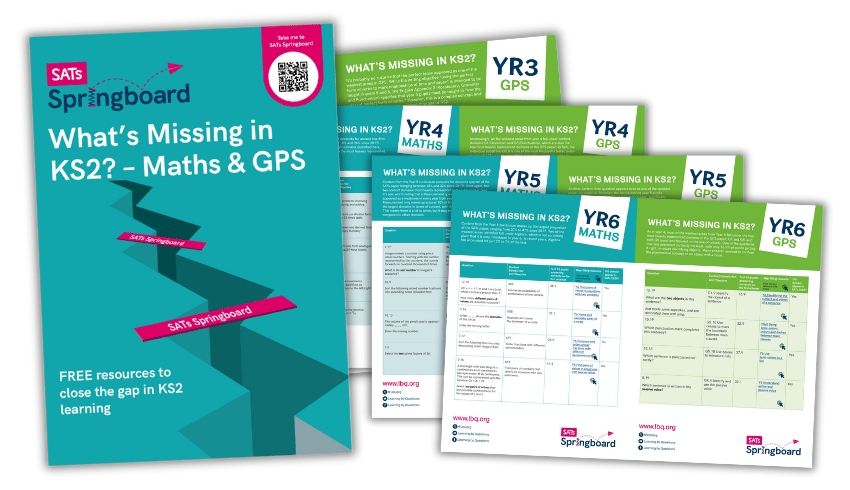
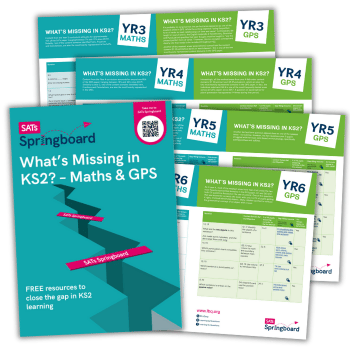
This SATs Springboard PDF identifies the biggest learning gaps across KS2 in maths and GPS, based on diagnostics from over 30,000 pupils.
It breaks down weak areas year by year, showing the percentage of Year 6 pupils who answer each question correctly and highlighting topics that frequently appear in SATs.
For each gap, it provides links to free, targeted resources to help teachers address them quickly. Overall, it acts as a data-driven reference for spotting exactly what pupils struggle with and what to focus on in class.
Maths
Take maths for example, where Y3 content contributes around 10 per cent of the SATs paper, according to data provided by Learning by Questions.
Fractions and calculations – introduced early – remain among the most heavily tested. By Y4, pupils meet more complex fractions and scaling problems, with content from this year making up around a fifth of the SATs paper.
Y5, involving measurement and volume questions, then accounts for roughly a quarter of the marks.
GPS
And the picture in GPS is similar. Perfect tense and prepositions, that first appear in Y3, resurface again in Y5 and 6 and are a common weakness.
Apostrophes for plural possession, a Y4 expectation, have been tested over a dozen times in recent years, yet remain a stumbling block in Y6.
Learning gaps – a KS2 problem
Learning gaps like these aren’t Y6 problems — they are KS2 problems. Too often, pupils reach Y6 with misconceptions carried forward.
The teacher then spends months firefighting, trying to reteach content while simultaneously introducing algebra, ratio and complex punctuation. It’s an impossible task.
Putting support in place
However, it is possible to ensure no pupils drifts too far by identifying gaps and putting support in place early.
Regular analysis of assessment data is vital, and the insights provided throughout KS2 enable teachers to see which objectives need revisiting – in real time.
Low-stake assessments can enable same-day intervention, so that end-of-term assessments are only really needed to provide data for the governors.
Benefits
The result is that both teachers and children perform better. Since applying this approach at our school, we’ve seen combined scores increase from 58 per cent to 87 per cent. Greater depth scores have risen from 0 to 21 per cent.
Plus, the benefits extend beyond the numbers. I remember a particular pupil who had severe special needs. Gaps in her learning had arisen lower down the school. However, tech tools enabled us to identify these in Y4.
Our KS2-wide team worked alongside her parents to address these. She made such great progress that she succeeded in achieving the expected standard.
Working together on learning gaps
Working together made the difference. A joined-up strategic approach, focused on clarity and collaboration, is key.
Each year group must understand its role. For example, if pupils leave Y5 fluent in the first 20 questions of an arithmetic test, Y6 can then focus on the final 20, rather than reteaching basics.
Phase meetings are crucial, too. Sitting down as a KS2 team allows teachers to share where children are secure and in what areas consolidation is needed.
Practical steps can include:
- Mapping backwards by identifying the high-value objectives most likely to appear on SATs and plan when they are introduced, revisited and secured.
- Setting clear end points for each year group, in arithmetic fluency benchmarks or grammar knowledge, that pupils must master before moving on.
- Revisiting tricky concepts little and often, such as fractions, measurement and verb tenses.
- Sharing practice across KS2 and encouraging Y3 and 4 teachers to see their work as the foundation for success.
SATs are intense. But when teachers across KS2 take shared ownership, leaders set out clear expectations for each year, and assessment is used to keep up, not catch up, we find a way forward that works for everyone. One that teaches SATs for what they truly are: a KS2 test.
Andy Done is headteacher at Masefield Primary School and leadership ambassador at Learning by Questions.
Similar resources
- Dragonborn – Write a big transition scene
- Teaching Dickens – Creative exercises to try in primary
- A Girl’s Guide to Spying – KS2 WW1 book topic
- Poetry prompts with Joseph Coelho – Author In Your Classroom ep 29
- Bring mythology into the modern world with Louie Stowell – Author In Your Classroom ep 28