


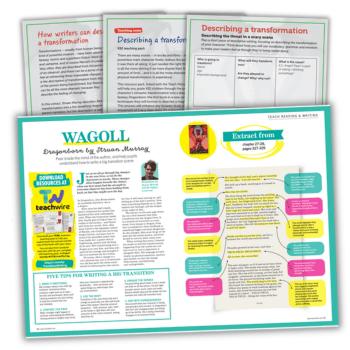
Peer inside the mind of author Struan Murray and help pupils understand how to write a big transition scene with this WAGOLL based on Dragonborn.
There are many stories – in books and films – in which a frustrated and powerless main character finally realises the power they have in themselves; it was there all along: it just needed the right thing to set it free.
This moment is all the more stirring if we have shared their frustration for an extended amount of time… and it is all the more dramatic when there is an actual physical transformation to experience.
This resource pack will help you guide KS2 children through the process of analysing the main character’s climactic transformation into a dragon in Struan Murray’s gripping fantasy Dragonborn (the first book in a new series) and selecting the techniques they will borrow to describe a magical transformation of their own.
This process will enhance any broader study of the novel, or simply increase enjoyment of it as a class story; it’s a powerful extract in its own right, but it will have most impact if children have experienced the character’s frustration at her inability to transform, making this moment especially rewarding.
If used in isolation, the extract could be positioned as a trailer, inspiring children to read the novel in order to discover what has led to this extraordinary moment.
Dragonborn writing resources included
- Extract from Dragonborn by Struan Murray
- ‘How writers can describe a transformation’ poster
- ‘Exploring writers’ techniques’ worksheet
- ‘Exploring writers’ techniques’ working wall display
- Planning sheet
5 tips for writing a big transition
Dragonborn author Struan Murray offers his advice…
Make it emotional
Big changes always come with big emotions. Sometimes these emotions might even be at odds – like fear and excitement. Build such clashing emotions into your writing to help the moment feel real and relatable.
Control the pace
Major changes might happen in seconds, while feeling like lifetimes. Varying sentence lengths help mirror what your character is experiencing emotionally – short sentences can speed things up, while longer ones can build pressure.
Use the body
Transitions in life, even those that don’t change us physically, are often felt inside before they happen. Describe physical sensations – heat, pressure, pain, relief – so the reader is right there with your character at this critical moment, feeling what they do.
Engage the senses
The great thing about books is that a writer can draw on all five senses, not just sight. Consider sound, touch, taste and smell. Sensory details help pull the reader into the moment and make the transition vivid.
End with consequences
Ask yourself what your character is losing and gaining in this moment. In Dragonborn, Alex isn’t just changing shape, but letting go of her old life. She is being irreversibly changed on an emotional level.
What is Dragonborn about?
In Dragonborn, Alex Evans makes an incredible discovery: she is a dragon. Ever since her dad’s death, Alex’s overprotective mother has smothered her with unbreakable rules.
When the frustration inside Alex finally gets too big to bear, it rushes to the surface… and flames spill from her mouth.
Now, Alex must travel to the legendary island of Skralla, one of the last surviving dragon havens, and learn how to control the incredible power that lives inside her: a power that is frightening, painful and thrilling all at once.
But transforming into a dragon is no easy feat, and Alex will need all her courage and strength if she is to embrace the fire within.
Of course, Alex’s change is a very physical one, but it is emotional too: she has spent the whole novel afraid of embracing her new nature, for fear it will mean moving on, and letting go of her dad’s memory.
Now, when everything depends on it, Alex masters her feelings, and the dragon in her wakes at last…
Thank you to Lindsay Pickton for creating the resource pack. Browse more WAGOLL packs from real authors or listen to an epiosde of our Author In Your Classroom podcast with Struan Murray.
Similar resources
- Teaching Dickens – Creative exercises to try in primary
- A Girl’s Guide to Spying – KS2 WW1 book topic
- Poetry prompts with Joseph Coelho – Author In Your Classroom ep 29
- Bring mythology into the modern world with Louie Stowell – Author In Your Classroom ep 28
- Plan an action story with Jason Rohan – Author In Your Classroom ep 27