

Teachers might not like to hear it, but some subjects can’t help feeling more… dynamic than others.
Sure, there will be some theoretical mathematicians beavering away out there on something involving cutting-edge quantum mechanics – but the process by which your students calculate the circumference of a circle isn’t going to change from one year to the next.
Citizenship teachers can arguably tell a different story, however.
When your subject involves teaching students how the institutions of government and civic society are supposed to operate, what are you meant to do when you turn the TV on at night and hear prominent voices argue for the scrapping of international treaties? Or how certain long-standing Parliamentary procedures and legal precedents need no longer apply?
If you follow what’s going on across the Atlantic – as many curious children and teens do – then you too can witness the spectacle of an elected government blithely casting aside legal due process on a daily basis. When what students hear in the classroom contrasts so sharply with what they see happening in the wider world, where does that leave teachers?
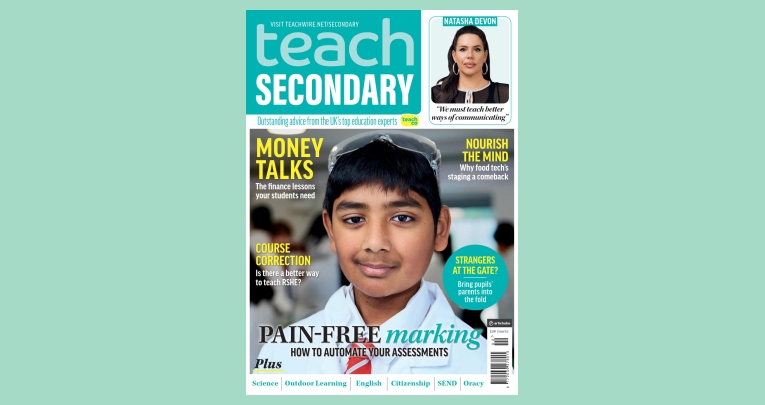
As citizenship specialist Helen Blachford discusses on page 50, finding yourself fielding considered questions from students about the ever-turbulent news cycle can be invigorating for a teacher – but also necessitates some careful managing of expectations, unpicking of myths and signposting to reliable information.
“When what students hear in the classroom contrasts so sharply with what they see happening in the wider world, where does that leave teachers?”
Not so long ago, one of the big questions occupying the profession was what the role of education should be in an age when anyone can simply Google whatever facts, figures and details they wish at any time. It doesn’t seem to be getting asked as much now.
For a glimpse of how Google envisages its role in the years ahead, look no further than the pithy AI generated summaries that now sit atop the search engine’s results page. (Indeed, many users now don’t).
Five years ago, there was plenty of discussion around the risks of online disinformation, and if/how students should be taught how to spot it. Given the terrifying speed with which industrial quantities of pure fiction dressed up as fact can now be rendered via convincing sound recordings and video footage, however, it can almost feel as if the battle against weaponised propaganda is already lost.
Still, on the plus side, if the tech titans want to make the internet less reliable in the pursuit of profit, that at least throws into sharp relief what the role of education perhaps ought to be:
A bulwark against those determined to obfuscate and mislead. A way of keeping young people grounded in reality. And a light with which to see ourselves – and the different futures that may one day be possible – that much more clearly.
Enjoy the issue,
Callum Fauser – Editor
callum.fauser@theteachco.com