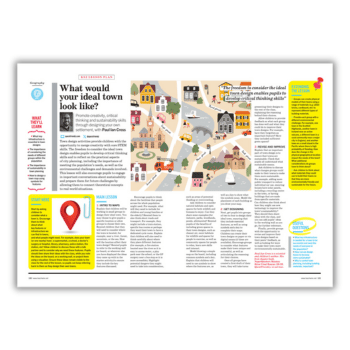


Promote creativity, critical thinking and sustainability skills by designing your own settlement with Paul Ian Cross’s town planning lesson plan…
Town design activities provide children with the opportunity to merge creativity with core STEM skills. The freedom to consider the ideal town design enables pupils to develop critical thinking skills and to reflect on the practical aspects of city planning.
This includes the importance of meeting the population’s needs, as well as the environmental challenges and demands involved.
This lesson will also encourage pupils to engage in important conversations about sustainability and prepare them for future challenges by allowing them to connect theoretical concepts to real-world situations.
Town planning learning objectives
- Know what key infrastructure is essential in town designs
- Consider the needs of different groups within the population
- Understand the importance of sustainability in town planning
- Learn how to design a town map using symbols for features
Starter activity
Start by asking children to consider what a town is. Encourage them to think about what key features or infrastructure we can find in towns, and what people might need.
For example, does your town (or one nearby) have a supermarket, a school, a doctor’s surgery or hospital, library, pharmacy, police station, fire station, etc?
Allow children to discuss these with a talk partner and to consider why we need these features. Pupils should then share their ideas with the class, while you note the ideas on the board, on a working wall, or project them using a visualiser.
Ensure these ideas remain visible to the class for the rest of the lesson, so pupils can keep referring back to them as they design their own towns.
Dr Paul Ian Cross is a scientist and children’s author. His first chapter book, SuperQuesters Mission: River Crest Rescue (£6.99, QuestFriendz), is out now.